
How to Measure a Concrete Patio — Square Footage Guide
Step-by-step instructions for calculating patio square footage — whether you are quoting a concrete pour, a paver install, a sealer coat, or a pressure washing job. Covers simple rectangles, L-shapes, multi-section layouts, and irregular cutouts.
Last updated: June 2026
The Manual Method — Step by Step
Identify the shape
Is it a simple rectangle? L-shaped? Does it wrap around a corner or have sections added at different times? Note any cutouts — fire pits, planters, posts — that break up the surface.
Break it into rectangles
Divide L-shapes and irregular layouts into simple rectangular sections. Sketch each section and label the dimensions you plan to measure.
Measure each section
Run a tape across the length and width of each rectangle. If a dimension varies (e.g., a patio that tapers), take measurements at both ends and use the average.
Calculate, subtract cutouts, add buffer
Multiply each section (L × W), sum the totals, then subtract cutouts. Add 10% for concrete and coatings, or 10–15% for pavers with complex patterns.
The Formula
(Section A: L × W) + (Section B: L × W) − Cutouts = Net Square Footage
Example: A 20 × 14 ft main patio (280 sq ft) plus an 8 × 10 ft side section (80 sq ft), minus a 4 × 4 ft fire pit base (16 sq ft) = 344 sq ft net. Add 10% buffer for materials = order for 378 sq ft.
Add up your patio sections
Break the layout into rectangles the way the steps above describe, then subtract anything you're not surfacing — a fire pit, a planter, a tree cutout.
Patio section
Subtract: Cutout
Fire pits, raised planters, and outdoor kitchen footprints all reduce the area you're actually pouring or sealing.
Total area
0sq ft
0 sq yd
0.000 acres
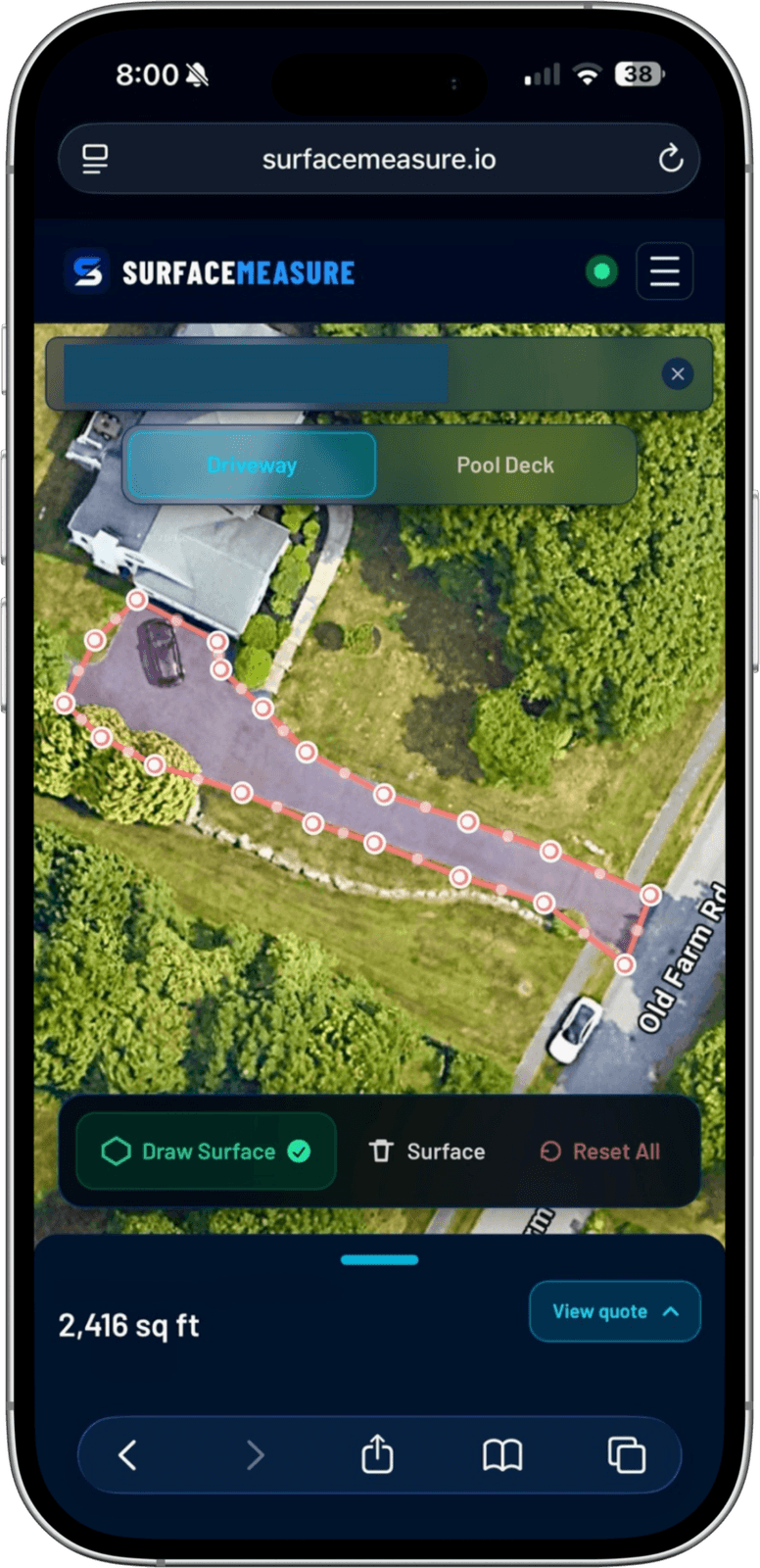
Length × width only works on straight, rectangular sections. For curves, freeform shapes, or edges you can't easily reach with a tape, trace the real shape on satellite imagery and let the area calculate itself.
Typical Patio Sizes for Reference
Use these as a sanity check after measuring. If your number is far outside this range, re-check your dimensions before ordering materials.
| Patio Type | Typical Dimensions | Square Footage |
|---|---|---|
| Small patio | 10 × 12 ft | 120 sq ft |
| Standard patio | 16 × 18 ft | 288 sq ft |
| Large patio | 20 × 24 ft | 480 sq ft |
| Wraparound / L-shape | Varies | 400–800 sq ft typical |
| Commercial / pool surround | Varies | 800–2,000+ sq ft |
Skip the Site Visit — Measure from Satellite
Patio shapes are rarely simple. Most have L-sections, cutouts, curved edges, or multiple zones installed at different times. Measuring all of that manually — with a tape — takes time and leaves room for error. SurfaceMeasure lets you trace the exact patio outline on a satellite image and get accurate square footage without leaving your office.
- ✓Handles L-shapes, wraparounds, and multi-zone patios
- ✓Cutouts traced directly — no mental subtraction required
- ✓Georeferenced imagery — measurements map to real-world distances
- ✓PDF export with labeled area for client quotes
How it works
Common Questions
Length × Width = Square Footage for a simple rectangle. A 20 ft × 15 ft patio = 300 sq ft. For multi-section layouts, calculate each rectangle separately and sum the totals.
Measure the full outer footprint, then subtract each cutout. A 400 sq ft patio minus a 25 sq ft fire pit base = 375 sq ft of workable surface. Only subtract features that won't receive the coating, seal, or pavers.
Yes — measure from the house wall (or the nearest fixed edge) to the outer edge of the patio surface. The material runs to the wall, so include that area in your total.
10% for concrete, coatings, and sealers. 10–15% for pavers depending on the pattern — diagonal and herringbone patterns need more cuts. It is always cheaper to order a bit extra than to reorder mid-job.
Yes. SurfaceMeasure uses georeferenced satellite imagery, so traced measurements map to real-world dimensions. Most residential patios measure within a few percent of a physical tape — accurate enough for professional estimates.
Split it into two rectangles, calculate each, and add them. For a wraparound with more than two sections, treat each wing separately. SurfaceMeasure lets you trace the full outline in one pass and calculates the total area automatically.
Measure your next patio in under 5 minutes
Also see: How to measure a driveway · Pressure washing estimator · All measurement resources