
How to Measure a Driveway — Square Footage Guide
Step-by-step instructions for calculating driveway square footage — whether you have a tape measure in hand or need to quote a job remotely from satellite imagery.
Last updated: June 2026
The Manual Method — Step by Step
Identify the shape
Is it straight, L-shaped, curved, or does it flare at the street apron? Complex shapes need to be broken into rectangular sections.
Measure length
Run a tape along the center of the driveway from the door threshold or garage slab to the street edge. Record in feet.
Measure width
Measure width at multiple points. Use average width for a consistent driveway, or calculate each section at its actual width.
Calculate and add buffer
Multiply each section: Length × Width. Sum all sections. Add 10% for concrete or asphalt, 10–15% for pavers.
The Formula
Length (ft) × Width (ft) = Square Footage
For a driveway with sections, calculate each section and sum them. Example: A 50 ft main run at 12 ft wide (600 sq ft) plus a 14 ft apron at 18 ft wide (252 sq ft) = 852 sq ft total.
Run the numbers on your driveway
You have the formula — here it is as a working calculator. Add a section for the main run and another for the apron or garage pad, and the totals add themselves.
Driveway section
Total area
0sq ft
0 sq yd
0.000 acres
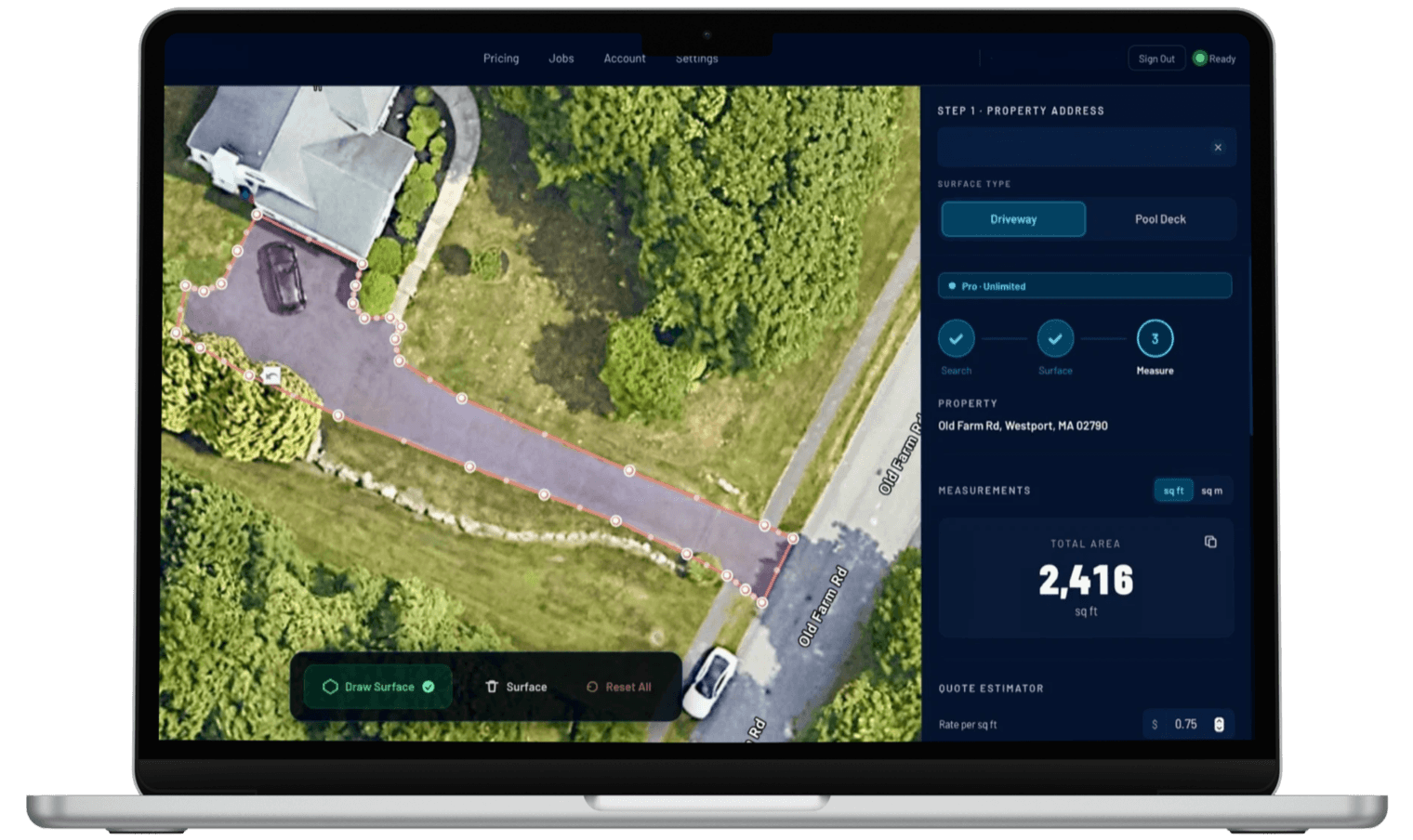
Length × width only works on straight, rectangular sections. For curves, freeform shapes, or edges you can't easily reach with a tape, trace the real shape on satellite imagery and let the area calculate itself.
Skip the Site Visit — Measure from Satellite
SurfaceMeasure lets you search any address, trace the driveway outline on a satellite image, and get an accurate square footage reading — without leaving your office or truck.
- ✓Works on straight, curved, and multi-section driveways
- ✓Handles irregular shapes and wide aprons automatically
- ✓Georeferenced imagery — not pixel estimates
- ✓PDF and image export for quotes and proposals
How it works
Common Questions
For a straight rectangular driveway: Length × Width = Square Footage. A 60-foot by 12-foot driveway = 720 sq ft. For L-shaped or multi-section driveways, divide into rectangles, calculate each, and add them together — an L-shape is just two rectangles sharing a corner, so a 40 × 12 ft run plus a 20 × 20 ft pad is 480 + 400 = 880 sq ft. Don't forget the street apron: the flared section where the driveway meets the road typically adds 150–400 sq ft and is easy to leave out of a length-times-width estimate.
Measure the center-line length and multiply by average width. To find average width on a tapering driveway, measure it at three points — top, middle, and bottom — and use the mean; that keeps the error within a few percent for most shapes. For precision on genuinely irregular shapes, trace the actual outline on a satellite image with SurfaceMeasure — a traced polygon follows the real curve instead of approximating it as rectangles, which is where manual measurements of curved driveways usually go wrong.
Single-car driveways are typically 10–12 ft wide. Two-car driveways are 18–24 ft wide, and three-car layouts commonly run 28–36 ft across the widest section. If your driveway tapers or flares, calculate each section at its actual width and add them together rather than averaging across the whole run — a 20-ft flare averaged into a 12-ft run understates the flare and overstates the run, and the errors don't cancel on material orders.
10% is standard for concrete and asphalt. Use 10–15% for pavers — more if the pattern requires many cuts. It is always cheaper to order slightly more upfront than to reorder with a different batch.
Yes. SurfaceMeasure uses georeferenced satellite imagery so measurements correspond to real-world dimensions. Most residential driveways measure within 1–3% of a tape measurement — accurate enough for professional estimates, material orders, and quotes. In dollar terms, even a worst-case 3% miss on a 2,000 sq ft driveway priced at $0.15 per square foot is about $9 — smaller than the fuel cost of driving out to measure by hand. Contractors typically measure remotely first and save the site visit for jobs that actually book.
It depends on the scope of work. Measure both separately to give clients a clear line-item breakdown — a typical two-car garage pad adds roughly 400–500 sq ft, which is a meaningful line on a cleaning or sealing quote. For total material orders, only include what you are actually installing; for cleaning work, quoting the pad separately lets the client drop it without renegotiating the whole job.
Measure your next driveway in under 5 minutes
Also see: Remote measurement for contractors · All measurement resources