
How to Quote Commercial Pressure Washing Jobs
Storefronts, HOAs, sidewalks, and parking areas — bid them on production rates and labor math, not guesswork.
Commercial work is where pressure washing businesses get predictable. The rates per square foot are lower, the areas are bigger, and the buyer expects a professional proposal. Here's the full process.
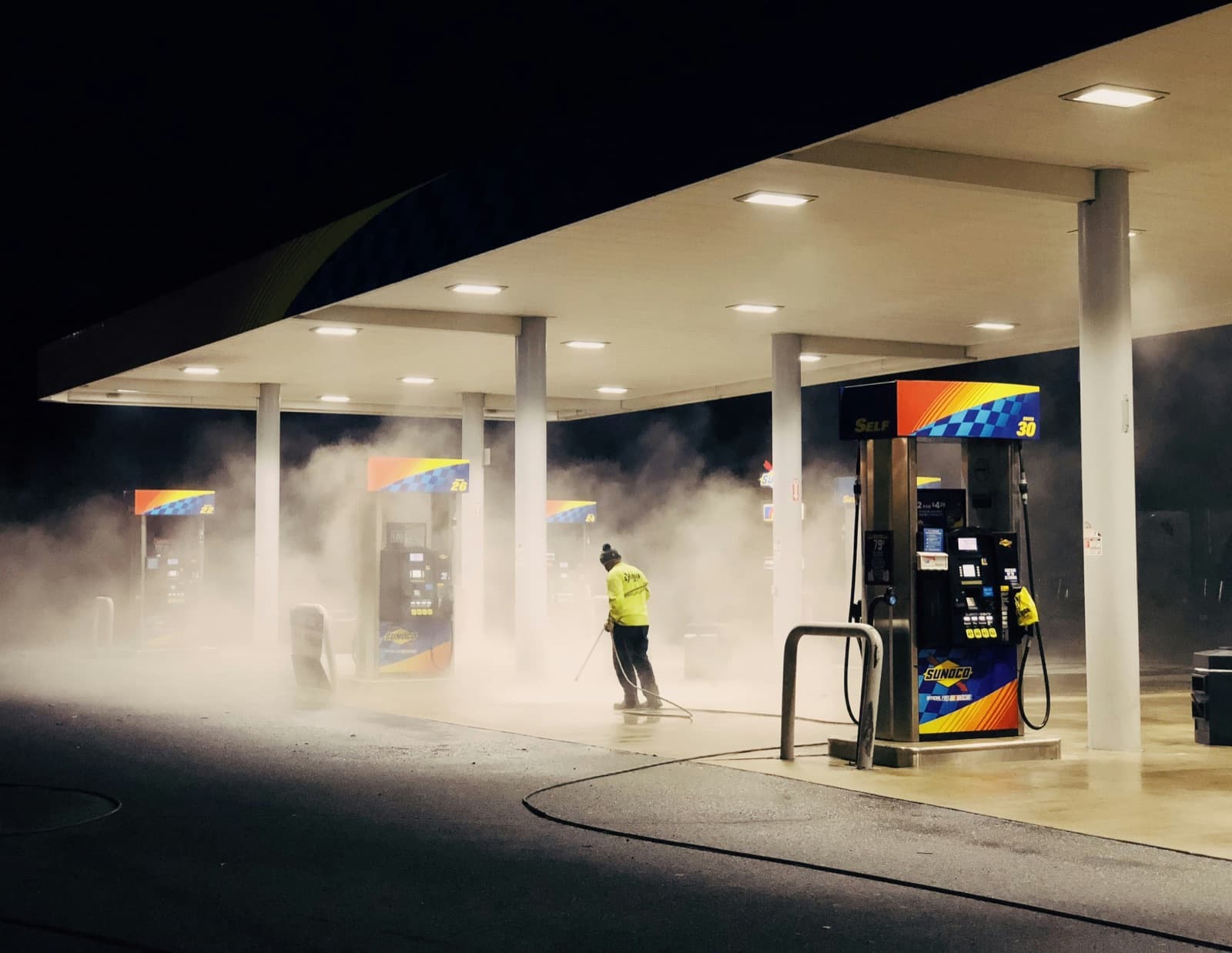
Commercial Is a Different Game Played With the Same Wand
The physics don't change — the economics do. Residential is high rate, low volume, instant payment. Commercial is lower rate, high volume, Net 30, and recurring. You win residential jobs with speed and reviews; you win commercial accounts with professionalism and reliability — the sourcing, vendor qualification, and bid-package side of that is covered in how to win commercial and HOA contracts. This page is the pricing half.
That changes how you quote. A homeowner reads a price; a property manager reads a proposal. They need scope by zone, proof of insurance, service windows that don't disrupt tenants, and a number their budget can absorb every quarter — not just once.
The good news: most of your competitors send commercial buyers a residential quote. Doing this right puts you in the top tier immediately.
Map the Site, Zone by Zone
Never bid a commercial property as one blob of square footage. Break it into zones — storefront sidewalks, rear walkways, dumpster pads, drive lanes, entry aprons — because each zone cleans at a different speed and earns a different rate.
Measure each zone from satellite before you ever visit. Commercial sites are exactly where remote measurement pays off most: a strip mall's sidewalks might run 300+ feet, and pacing them off with a measuring wheel takes an hour you don't bill for. Tracing the same zones on satellite imagery takes minutes, and you arrive at the walkthrough with the numbers already in hand. The parking lot calculator and sidewalk calculator cover the two zones that carry most of the area.
Then do the walkthrough anyway — on commercial you're not walking to measure, you're walking to spot the things imagery can't show: gum density, grease around the dumpster corral, water access, storm drains, and anything that changes your production rate.
- ✓Storefront sidewalks & entry aprons
- ✓Rear walkways and service corridors
- ✓Dumpster pads & corrals (count them)
- ✓Drive lanes, parking areas, curbs
- ✓Water access — spigots or bring a tank?
- ✓Storm drains — runoff/reclaim rules?
- ✓Service window — nights? weekends?
Turn Square Footage Into Hours
Commercial bids live or die on production rates — how many square feet your rig actually cleans per hour. Residential contractors rarely track this; commercial operators know their number cold.
Divide each zone's square footage by a realistic rate for that zone type, add setup and water time, and you have crew hours. That hours number is the real cost of the job — everything else is margin math.
Track your actual rates on the first few commercial jobs and replace these ranges with your own numbers. Your bids get sharper every job.
Where you land inside that 800–1,500 range is mostly cleaner width — the surface cleaner size guide breaks the rate down by size and tells you which one your machine can actually drive.
Price Per Foot, Check Per Hour
Quote each zone per square foot (dumpster pads flat per pad), because that's the format commercial buyers compare. But before the proposal goes out, run the sanity check: bid total ÷ estimated crew hours ≥ your hourly floor.
Most solo operators need $125–$175 per crew-hour on commercial work to cover equipment, insurance, night premiums, and Net 30 float. If the per-foot math lands below your floor, raise the rate or walk — a big job at $60/hour is just a big way to lose money.
Always present two prices: the one-time cleaning and the recurring program (monthly or quarterly at 10–20% off). The recurring line is the business you actually want, and it reframes the one-time price as the expensive option.
Every commercial rate by property type is in the commercial pressure washing rates guide — and the commercial pressure washing calculator builds the zone-by-zone math for you.
Price a commercial bid
Commercial work trades a lower per-foot rate for volume, which makes the square footage the number you can least afford to guess at.
Area
Your pricing
This page's ranges: $0.05–$0.20 per sq ft overall, with storefront sidewalk typically $0.08–$0.14. Add a mobilization minimum if your bids carry one.
Estimated bid
$0
An estimate, not a quote — your costs, market, and the surface condition move the real number. Don't know the square footage? Measure it from satellite imagery and the area fills itself in.
Send a Proposal, Not a Price
A commercial proposal is how a property manager justifies choosing you to their boss or their board. Give them everything they need to say yes without a second email: scope by zone with measured square footage, exclusions, insurance, service windows, and terms.
Attach your certificate of insurance up front — $1M general liability is the usual minimum, and many management companies want to be named as additional insured. Having the COI ready before they ask signals you've done this before.
Then follow up on a business cadence: within the week, then monthly. Commercial approvals are slow, and the vendor who stays politely visible usually gets the account when the incumbent slips.
- ✓Scope by zone, with measured sq ft per zone
- ✓Exclusions (oil that may not fully lift, etc.)
- ✓One-time price AND recurring program price
- ✓Service window (nights/weekends) confirmed
- ✓Certificate of insurance attached
- ✓W-9 and any vendor onboarding docs ready
- ✓Payment terms stated (Net 30 is standard)
- ✓Before/after photos from similar properties
Worked Example: Strip Mall Bid
Hours: storefront + rear walkway ≈ 4.5–5 hrs with a surface cleaner (gum slows the frontage), pads ≈ 2 hrs with degreaser, setup/water ≈ 1 hr → ~7.5 crew hours.
$1,095 ÷ 7.5 hrs = $146/hr effective — above a $125–$175 floor. The quarterly line turns one bid into $3,940/year of recurring revenue.
Common Commercial Bidding Mistakes
Pricing commercial like residential
Commercial rates per square foot are lower — the job only works because of volume and repeatability. If you quote a 6,000 sq ft plaza at residential driveway rates, you'll lose to every established commercial operator in your market.
Skipping the hourly sanity check
Per-square-foot math can look fine and still land you at $60/hour once gum removal, night work, and setup time eat the margin. Always divide the bid total by realistic crew hours before sending it.
Ignoring water access and runoff rules
Some sites have no accessible spigot — you're bringing a tank. Some municipalities require wash-water recovery around storm drains. Both change your costs, and both are questions to ask before you price, not after you win.
Bidding one visit instead of a program
A one-time cleaning is an audition. The proposal should always include a recurring option — quarterly storefront service is the account you actually want, and buyers say yes to programs more easily than to repeated one-off approvals.
No night/weekend premium
Most storefront work happens when the business is closed. If your bid assumes daytime production but the property requires 10pm–6am service windows, you just donated your premium. Confirm the service window before pricing.
Where SurfaceMeasure Fits in a Commercial Bid
Commercial sites are the strongest case for satellite measurement: the areas are huge, the zones are many, and pacing them off on foot is an hour of unpaid work per bid.
Trace each zone — storefront runs, rear walkways, pads, lanes — as separate measurements and you have the zone-by-zone square footage that structures the whole proposal. For multi-site RFPs (HOA communities, franchise groups), you can measure every property in an afternoon without leaving the office.
Then walk the site once, for the things imagery can't show — and show up to that walkthrough with the numbers already done.
Commercial Bidding Questions
Rates, insurance, contracts, and getting paid.
Commercial flatwork typically runs $0.05–$0.20 per square foot — lower than residential rates, but at much higher volume. Open sidewalk at a shopping center might price near $0.08–$0.14/sq ft, while gum-heavy storefront frontage or grease-caked dumpster pads command more (pads are often priced flat at $75–$150 each). Always sanity-check the total against your hourly floor, not just the per-foot rate.
Most commercial properties require $1M general liability, and many property management companies ask for $2M aggregate, workers comp if you have employees, and a certificate of insurance (COI) naming them as additional insured before you can start. Have your COI ready to send with the proposal — asking a property manager to wait on your insurance paperwork is a common way to lose a bid you already won.
Yes — recurring service is the whole point of commercial work. Offer monthly or quarterly service at a 10–20% discount from the one-time price. The property gets a consistently clean site and a predictable budget line; you get route density and revenue you can plan around. One strip mall on quarterly service is worth more than ten one-off driveways.
Expect Net 30 terms — commercial invoices route through accounts payable, and 30–45 days from invoice to payment is normal. Price with that float in mind, invoice immediately with any required PO number or vendor codes, and don't let one anchor account become so large that a slow payment threatens your cash flow.
Related Resources
The rest of the quoting cluster.
Measure the Whole Property Before You Visit
Trace every zone from satellite, get zone-by-zone square footage, and walk into the site visit with the bid already built. First week free, card required, cancel anytime.