
The Pressure Washing Pricing Guide
What to charge, how to charge it, and how to protect your margin — the complete system, from cost floor to sent quote.
National averages don't pay your bills. This guide shows you how to build rates from your own numbers, then gives you the market ranges to sanity-check them against.
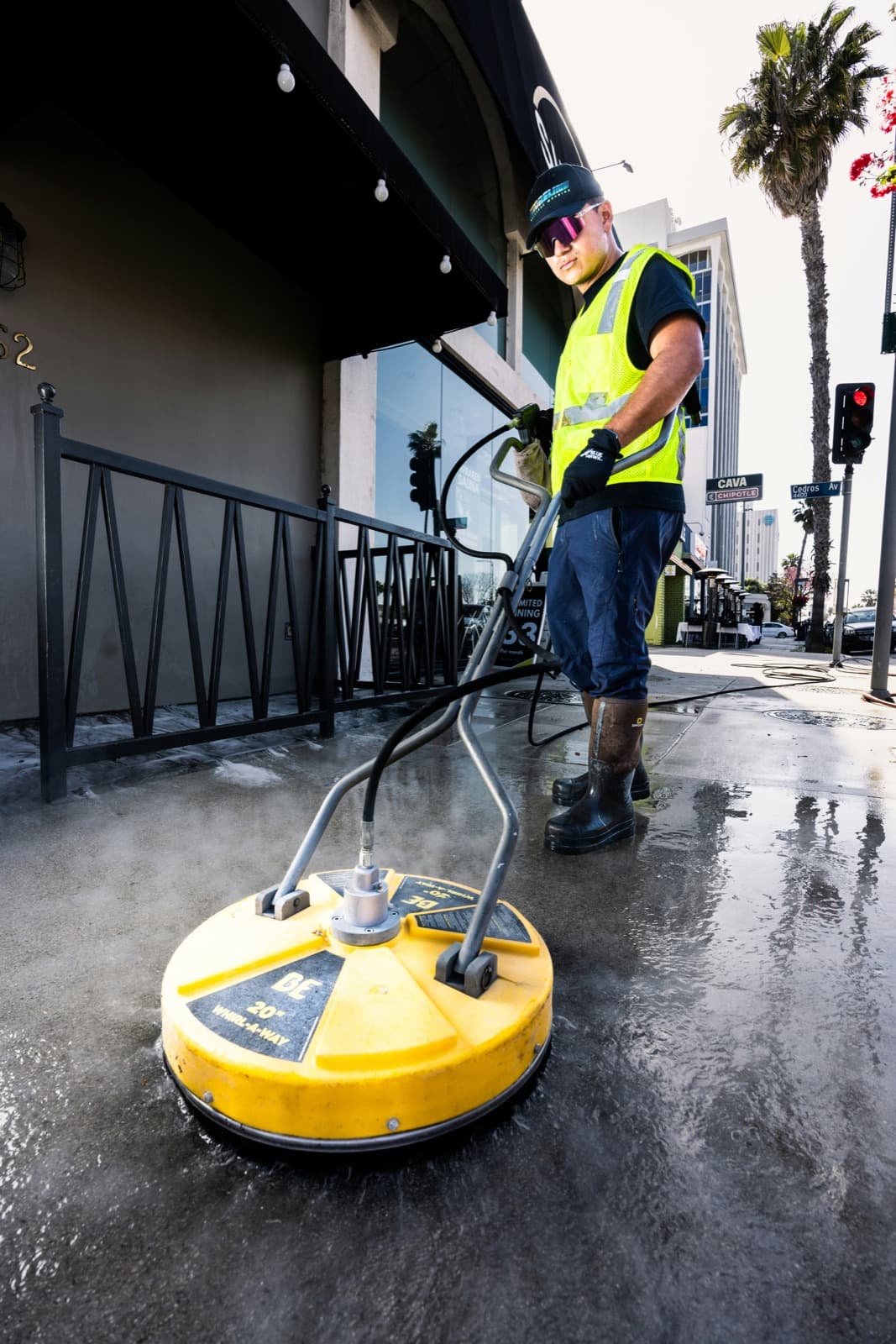
Every Profitable Price Has Three Layers
Contractors who guess pick a number. Contractors who last build one.
Cost floor
What an hour of your operation actually costs — truck, fuel, insurance, chemicals, equipment wear. Prices below this lose money no matter how busy you are.
Market rate
The per-square-foot range your market supports for each surface type. Your rate lives inside this range — where inside it depends on your positioning.
Job adjustments
Condition, access, travel, and bundling move the price up or down from base. This layer is where margin is protected — or quietly donated.
Layer 1: Know What an Hour Actually Costs You
Add up a month of real operating costs — truck payment and fuel, insurance, equipment depreciation, chemicals, phone, software — and divide by the hours you actually spend on jobs (not hours worked; billable hours on-site are usually half of your working week or less).
That number is your cost per billable hour. Most solo operators discover theirs sits between $45 and $70 — which is why a "quick $99 driveway" 40 minutes away is often a donation, not a job.
Your hourly target is your cost floor plus real wages plus profit — for most solo operators, $100–$175 per working hour. Every bid in this guide gets sanity-checked against it, and it's also the number your minimum charge is built from.
Before wages or profit. A $120 job that eats 2 hours with driving runs at $60/hr — barely above cost. This is why minimums exist.
Layer 2: Market Rates by Surface
US residential and commercial ranges as of 2026. Each linked surface has a full deep-dive with size tiers, scenarios, and the adjustments specific to that job type.
| Surface | Per sq ft | Typical job |
|---|---|---|
| Concrete driveway | $0.08 – $0.20 | $150 – $250 / job |
| Concrete patio / walkway | $0.08 – $0.18 | $100 – $200 / job |
| Pool deck (net area) | $0.10 – $0.25 | $180 – $400 / job |
| Pavers (clean only) | $0.15 – $0.35 | $200 – $450 / job |
| Commercial flatwork | $0.05 – $0.20 | $500 – $2,500 / visit |
Commercial work runs on its own price list. Most commercial flatwork costs $0.05–$0.20 per square foot, priced by property type and checked against a crew-hour floor rather than a job minimum — every rate, the flat pad prices and the contract discounts are on the commercial pressure washing rates page.
Put your rate to work
Once you've built a rate from your own costs, this is the arithmetic every quote runs on. Enter an area and your rate, and your minimum takes over when the job is too small to clear it.
Area
Your pricing
This page's ranges: $0.08–$0.35 per sq ft by surface, with typical residential jobs landing at $150–$250. The right rate comes from your costs, not an average.
Job price at that rate
$175
An estimate, not a quote — your costs, market, and the surface condition move the real number. Don't know the square footage? Measure it from satellite imagery and the area fills itself in.
Quote Per Foot. Verify Per Hour.
Per-square-foot pricing wins with customers: it looks calculated, it's easy to compare, and it scales to any property without renegotiating. Hourly pricing wins internally: it's the honest measure of whether a job made money.
So use both. Quote every job per square foot; before sending, divide the total by realistic on-site + drive hours. Above your hourly target → send it. Below → raise the rate, apply your minimum, or pass.
The full comparison — including when pure hourly is actually right — is in Hourly vs. Square Foot Pricing.
Clears a $100–$175 target. Same math on a 500 sq ft patio 40 minutes away fails the check — which is exactly what the minimum charge is for.
Layer 3: The Adjustments That Protect Margin
| Heavy staining, oil, rust, or organic growthMore dwell time, more chemical, more passes | +20–30% |
|---|---|
| Pavers or textured surfaces vs. smooth concreteSlower passes, joint care | +10–20% |
| Difficult access — slopes, gates, tight setupsSetup time is real labor | +15–25% |
| Long travel (30+ minutes each way)Windshield time isn't free | + trip fee or decline |
| Bundled surfaces (driveway + patio + walkway)You're already set up — share the savings | −10–15% on added surfaces |
| Repeat / seasonal customersCheaper than acquiring a new customer | −10% loyalty rate |
Regional Pricing: Your Zip Code Is a Multiplier
The ranges in this guide are national. Your market applies a multiplier on top, driven by cost of living, competition density, and season length.
High-cost metros (South Florida, coastal California, the Northeast corridor) routinely run 20–30% above national ranges — your costs are higher and so is the customer's reference point. Rural and low-cost markets run 10–20% below, but with less competition, minimums hold more easily.
Four-season markets compress the season into 7–8 months — which means your annual overhead loads onto fewer billable hours, and your rates need to be higher than a year-round market's, not lower. Sunbelt contractors price for volume; northern contractors price for the calendar.
The honest way to find your multiplier: quote at national mid-range for two weeks. Closing everything instantly? You're low — raise. Closing under half? Check your reviews and response speed before assuming it's price.
The Six Pricing Mistakes That Kill Margins
Copying competitor prices
The guy charging $99 for any driveway either has lower costs than you, no insurance, or no idea what his costs are. Two of those three go out of business. Price from your own cost floor, not someone else's desperation.
One rate for every surface
Pavers take half again as long as smooth concrete. Pool decks need edge care around coping. A single 'concrete rate' quietly donates your margin on every non-driveway job you touch.
Quoting without measuring
Every rate in this guide is per square foot — which means the square footage is the price. Eyeballing a 'medium driveway' that's actually 1,600 sq ft instead of 1,000 is a 60% pricing error before you've picked a rate.
No minimum charge
A $90 job that takes 45 minutes on site plus 50 minutes round-trip driving pays worse than most W-2 jobs once fuel and wear are out. Set a floor — most contractors land between $125 and $175 — and hold it.
Never raising prices
If you close almost every quote and you're booked three weeks out, you're the cheapest professional in your market. Raise rates on new quotes until your close rate settles around 60–70% — that's the profit-maximizing zone.
Ignoring the cost of getting paid
A price is only real when it clears. Same-day invoicing, instant payment options, and (on commercial) pricing in the Net 30 float are part of pricing, not an afterthought.
Rates Are Easy. Square Footage Is the Job.
Everything on this page multiplies against one number: measured square footage. Get it wrong by 20% and no rate table saves the quote.
SurfaceMeasure measures any driveway, patio, pool deck, or commercial site from satellite imagery in under a minute — net of pool cutouts, zone by zone — so every price you build starts from the right number, before you've driven anywhere.
Pricing Questions, Answered
What contractors ask most about rates, methods, and raising prices.
Most residential flatwork prices between $0.08 and $0.35 per square foot depending on the surface: concrete driveways $0.08–$0.20, patios $0.08–$0.18, pool decks $0.10–$0.25, and pavers $0.15–$0.35. But the right rate for your business comes from your costs, not a national average — calculate your hourly cost floor first, then set rates that clear it with margin on a typical job in your market.
Most established solo operators target $100–$175 per working hour on residential jobs and $125–$175 on commercial work. That's not what you quote the customer — it's the internal floor you check every per-square-foot bid against. If a quoted job works out below your hourly floor after drive time and setup, the rate is too low or the job is too small for the trip.
Quote per square foot, verify per hour. Per-square-foot pricing is easier for customers to accept and easier for you to scale, while your hourly floor keeps any individual bid from losing money. Hourly quoting makes sense only for unpredictable scopes like heavy rust removal or cleanup after construction.
Three reasons: cost of living (labor, insurance, and fuel cost more in metro areas), competition density (saturated markets compress rates), and demand seasonality (year-round markets like Florida behave differently from four-season markets). Expect real rates to run 20–30% above national ranges in high-cost metros and 10–20% below them in rural low-cost areas.
Raise rates on new quotes first — existing customers keep their price until their next seasonal service, when you present the new rate with a returning-customer discount that still nets above your old price. If you're booked more than two weeks out, that's the clearest signal your rates are below market: raise them until your close rate drops to roughly 60–70%.
Go Deeper on Your Job Type
Every page below drills into one pricing question.
Start Every Price From the Right Number
Measure the surface from satellite, apply your rate, and send a professional quote — all before your competitor schedules a site visit. Card required, cancel anytime.