
How to Start a Pressure Washing Business
You can be legally set up, insured, equipped, and quoting real jobs in about a month, for $2,500–$7,500. Here's the exact order to do it in.
Pressure washing has one of the lowest barriers to entry of any home service — which means the equipment isn't the business. The business is insurance, pricing, quoting speed, and reviews. This guide walks through all seven steps in launch order, with links to the deeper guide for each one.
Step 1 · Week 1
Register the Business Before the First Job
Most solo operators start as an LLC. It separates your personal assets from business liability — which matters in a trade where you point pressurized water at other people's property — and in most states it costs $50–$500 to file and under an hour online.
A sole proprietorship is faster and free, but there's no liability wall between a claim against the business and your personal savings. If you skip the LLC at launch, treat it as deferred, not skipped.
Then three quick tasks: get a free EIN from the IRS (10 minutes, irs.gov, never pay a third party for this), open a business bank account so job income never mixes with personal money, and call your city clerk about a local business license — many cities require one, and some areas have wastewater runoff rules for washing.
- File the LLC (or register your trade name)$50–$500 by state
- Get an EIN from irs.govFree · 10 min
- Open a business checking accountFree–$15/mo
- City business license (call the clerk)$0–$150/yr
- Check state contractor registration rulesVaries
Total: usually under $600 and one afternoon of actual work. None of it requires a lawyer for a single-owner operation.
Step 2 · Week 1–2
Get Insured — This Step Is Not Optional
Pressure washing is a low-startup-cost trade with real damage potential: water forced under siding, stripped paint, etched wood, cracked windows, chemical burns on plants. General liability insurance is what stands between one bad afternoon and personal debt — and for a new solo operator it typically runs $50–$150 per month.
Two things new operators consistently get wrong: relying on a homeowner's policy (it excludes business activity), and buying a generic policy that misclassifies the work. Make sure the policy explicitly covers pressure washing, and understand what GL does not cover — most policies exclude damage to the exact surface you're working on.
The full breakdown — the four policy types, real cost ranges, what affects premiums, and the exclusions that surprise people — is in our Pressure Washing Insurance Guide.
Day-one coverage
Commercial auto, equipment coverage, and workers comp come later — GL comes before the first paid job.
Step 3 · Week 2
Buy the Starter Kit, Not the Dream Rig
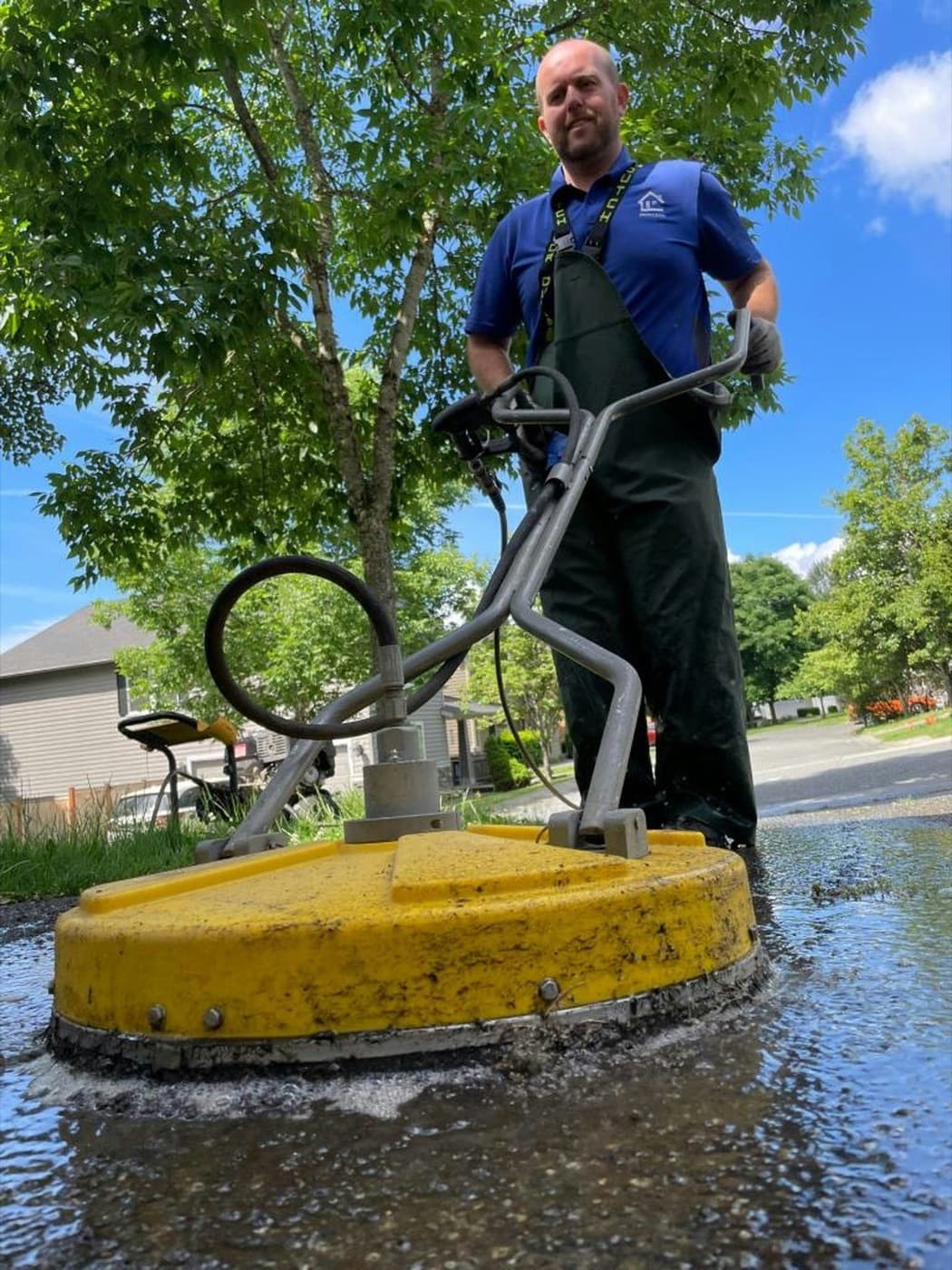
The single most expensive mistake new operators make is buying for the business they imagine instead of the jobs they have. Residential flatwork — driveways, patios, sidewalks, pool decks — is won with a belt-drive 4 GPM / ~4,000 PSI machine and a surface cleaner. That's it. GPM (water volume) determines speed; the surface cleaner determines finish quality.
Skip, for now: the 8 GPM machine, the trailer, the softwash system, the vehicle wrap. Every one of those is a great purchase after demand exists — and a payment book before it does.
The full itemized budget — three build levels with real price ranges — is in How Much Does It Cost to Start a Pressure Washing Business?
Assumes you already have a truck, SUV, or van that can carry it. Buying used from a contractor upgrading his rig can cut this by a third.
Step 4 · Week 2
Set Your Rates Before Your First Quote
Improvising a price on a customer's driveway is how new operators end up working weekends for less than minimum wage. Before the first lead, you need three numbers written down: a per-square-foot rate for each surface you serve (concrete runs $0.08–$0.20/sq ft in most markets), a job minimum that makes small jobs worth the drive (most contractors land between $125 and $175), and an hourly floor to sanity-check every bid against.
All three are built for you, with worked examples, in the Pressure Washing Pricing Guide — read it once and you'll price with more discipline than most operators who've been running for years. The minimum charge guide covers the floor specifically.
Rate per surface
$0.08–$0.20
concrete flatwork, per sq ft — pavers and decks run higher
Job minimum
$125–$175
no job below this leaves the driveway
Hourly floor
$100–$175
every quote gets checked against it
Price your first jobs
Setting a rate and holding a minimum are two of the first decisions you'll make. Try them here before you quote anything.
Area
Your pricing
This page's range: $0.08–$0.20 per sq ft in most markets. Build your rate from your own cost per billable hour, then set a minimum and hold it from day one.
Estimated job price
$0
An estimate, not a quote — your costs, market, and the surface condition move the real number. Don't know the square footage? Measure it from satellite imagery and the area fills itself in.
Step 5 · Week 3
Build the Quoting System Before the Leads Arrive
Here's the uncomfortable truth about this trade: the contractor who quotes first wins a disproportionate share of jobs, almost regardless of price. Your quoting system — how you measure, price, and deliver a number — matters more than any piece of equipment you own.
The professional version: when a lead texts you an address, you measure the driveway from satellite imagery, multiply by your rate, and send a written quote with the square footage on it — within the hour, without driving anywhere. That's exactly what SurfaceMeasure does.
Pair it with the free estimate template so your quotes look like they come from an established company. The full method is in How to Estimate Pressure Washing Jobs Without a Site Visit.
- Lead texts an address“How much for my driveway?”
- Measure it from satellitetrace the surface, get exact sq ft — ~60 seconds
- Apply your rate + minimum1,150 sq ft × $0.15 = $172.50
- Send a written quotesquare footage shown — looks measured, because it was
Step 6 · Week 3–4
Land the First Ten Customers
Forget paid ads for now. The first ten jobs come from three free channels — the full ranked list is in How to Get Pressure Washing Customers. In launch order: a Google Business Profile (the listing that appears in map results for "pressure washing near me" — set it up properly with our step-by-step GBP guide), your own network and street (neighbors watching you clean a driveway are the warmest leads you'll ever get), and before/after photos posted everywhere — your profile, local Facebook groups, Nextdoor.
The compounding asset is reviews. Ask on the spot, while the customer is standing on clean concrete — not by text that evening. Ten five-star reviews with photos will outperform any amount of early ad spend, and the follow-up templates include word-for-word review request scripts.
Step 7 · Month 1–3
The First 90 Days, Week by Week
Volume follows reputation. The first quarter is about reps, reviews, and response speed — not growth hacks.
- Practice on your own driveway until passes are even
- Photograph every surface before and after
- Set up Google Business Profile with real photos
- Do 2–3 jobs for neighbors at your real price
- Ask every customer for a Google review on the spot
- Post before/after pairs to your profile weekly
- Track every quote: sent, closed, or lost — and why
- Set a job minimum and hold it
- Work the streets you've already cleaned on
- Follow up on every open estimate at day 3 and day 10
- Raise rates if you're closing nearly everything
- Decide what you'll add next: soft wash, sealing, or commercial
Six Ways New Operators Sink Themselves
Buying the big rig first
An 8 GPM machine and a wrapped trailer don't generate leads — they generate payments. Nearly every residential job books the same whether you arrive with a $12,000 rig or a $1,500 machine that does clean work.
Spraying before you're insured
One oxidation streak down a vinyl wall or one cracked window can erase months of profit. General liability runs less per month than most operators spend on fuel — it's the least optional line in the budget.
Pricing by copying the cheapest guy
The $99-any-driveway competitor is either uninsured, unaware of his costs, or on his way out. Build your rate from your own cost floor and hold a minimum from day one.
Taking every job
Roofs, two-story houses, and painted wood are where new operators cause damage. Say yes to flatwork, learn soft washing properly, and refer out what you can't do safely yet — a declined job costs nothing; a claim does.
Slow, vague quotes
Homeowners hire whoever responds first with a real number. "I can swing by Saturday to take a look" loses to a same-hour quote with square footage and a price on it — speed is a competitive weapon that costs nothing.
No follow-up
Most estimates don't close on the first message, and most new operators never send a second one. A two-line follow-up text three days later is the cheapest revenue you'll ever recover.
These six are specific to launch. For the operational mistakes that show up after you're already running jobs, see 10 Pressure Washing Business Mistakes to Avoid.
Starting Out: What People Ask
Costs, licenses, part-time viability, and first-year earnings.
Most new operators launch for $2,500–$7,500. A lean start with a quality 4 GPM machine, surface cleaner, insurance, and legal setup lands near the bottom of that range; a fuller setup with a better machine and more accessories lands near the top. You do not need a $15,000 trailer rig to win residential work — see our full startup cost breakdown for an itemized budget at three levels.
It depends on where you operate. Most cities require a general business license, and some states require a contractor registration for exterior cleaning above a revenue threshold. Separately, some municipalities enforce wastewater and runoff rules. Call your city clerk's office and check your state's contractor board — it usually takes one afternoon to find out.
Yes, and many successful operators start exactly that way — weekends and evenings while keeping a paycheck. Part-time works because jobs are discrete: a driveway is a 2–3 hour commitment, not an open-ended engagement. The main cautions are insurance (you need it from job one, even part-time) and response speed, since leads that wait days go to whoever answered first.
It depends almost entirely on how many quotes you send and close, not on equipment. A part-time operator doing 2–3 jobs per weekend at a $200–$300 average ticket grosses roughly $20,000–$45,000 in a season. Full-time operators in year one commonly land between $40,000 and $80,000 gross. Margins on that revenue are strong — see our profitability guide for the actual math.
You need competence, not a résumé. Flatwork — driveways, patios, sidewalks — is learnable in days of deliberate practice on your own property. What separates professionals is knowing what NOT to spray: high pressure on vinyl siding, roofs, and painted wood causes real damage. Start with flatwork, learn soft washing before touching houses, and never take a job you'd be practicing on.
The Rest of the Launch Reading
Each step above has a deeper guide behind it.
Your Quoting System, Ready on Day One
When the first lead texts an address, measure it from satellite and send a real quote in minutes — before the other guy has even called back. First week free, card required, cancel anytime.