
How to Measure for Pressure Washing
How to calculate square footage for driveways, pool decks, patios, and multi-surface jobs — so you can price with confidence.
First week free · Card required · Cancel anytime · Last updated: June 2026
Measuring Square Footage by Surface Type
Measuring a Driveway for Pressure Washing
For a straight rectangular driveway, length × width gives you gross square footage. Width standards: single-car 10–12 ft, two-car 18–24 ft. If you're measuring at the street, add the apron — the flared section connecting the driveway to the road. Aprons are frequently the dirtiest part of a driveway and are often forgotten in the initial square footage count.
For curved driveways, measure the center-line length — the distance running down the middle of the driveway — and multiply by the average width. This gives a solid approximation for gentle curves.
Measuring a Pool Deck for Pressure Washing
Pool deck pressure washing jobs are priced on net washable area — the deck surface you're actually cleaning, not including the pool itself. To get net area, measure the total footprint including the pool, then subtract the pool surface area.
Residential pool decks typically range from 600 to 1,200 sq ft net. Larger properties with wraparound decks or commercial pool areas can be significantly larger. If the job includes the pool coping, measure that separately — it's a different surface treatment and a useful line item on the quote.
Measuring a Patio for Pressure Washing
For a simple rectangular patio, multiply length by width. For L-shaped or irregular patios, divide into rectangles, calculate each section, and add the totals. Exclude the footprint of any large permanent furniture or built-in planters that won't be moved during the wash.
Typical residential patios range from 200 to 500 sq ft. A large covered outdoor living area can reach 700–900 sq ft. Pavers, concrete, and natural stone are all common patio surfaces — each may wash at different speeds, but measurement is the same regardless.
Measuring Siding and Fence — the Vertical Surfaces
Everything above is flat ground, where length × width is the whole measurement. The two surfaces on a residential quote that don't work that way are the house itself and the fence, and both go wrong in the same direction: the number that's easy to get is much smaller than the surface you actually clean.
A house wash is priced off perimeter × wall height, not the footprint. On a typical two-story home the siding is about 2.3× the footprint, so quoting the flat area you can see from overhead bids roughly a third of the job. A fence is measured in linear feet but cleaned in square feet — linear feet × height × faces — and a per-linear-foot rate charges the same for a 4 ft picket and an 8 ft privacy run.
Quoting Multi-Surface Jobs
Most full-property pressure washing jobs include more than one surface type. When a job covers a driveway, pool deck, and patio, measure each separately. Surface conditions, cleaning time per square foot, and sometimes rates differ between surfaces.
Keeping separate measurements gives you flexibility: you can price the full job as a package, break it into line items on the quote, or let the customer pick which surfaces to include.
The surface most often left off is the walkway — small enough to eyeball, common enough to appear on nearly every property. The sidewalk calculator handles it, the deck calculator covers wood and composite decks, and the parking lot calculator scales the same workflow up to a commercial site.
Two surfaces need a different technique than the rest. A roof is traced flat and then multiplied by a pitch factor, since a slope covers more surface than its footprint. A garage floor isn't visible from above at all — you trace the building outline and work back to the slab underneath.
Measure each area in a single satellite session. No driving required.
Total up the surfaces you're washing
Most jobs are more than one surface. Add a row per surface — driveway, walkway, patio — and the combined square footage is what your rate applies to.
Surface
Total area
0sq ft
0 sq yd
0.000 acres
Length × width only works on straight, rectangular sections. For curves, freeform shapes, or edges you can't easily reach with a tape, trace the real shape on satellite imagery and let the area calculate itself.
Measure Any Pressure Washing Job Remotely
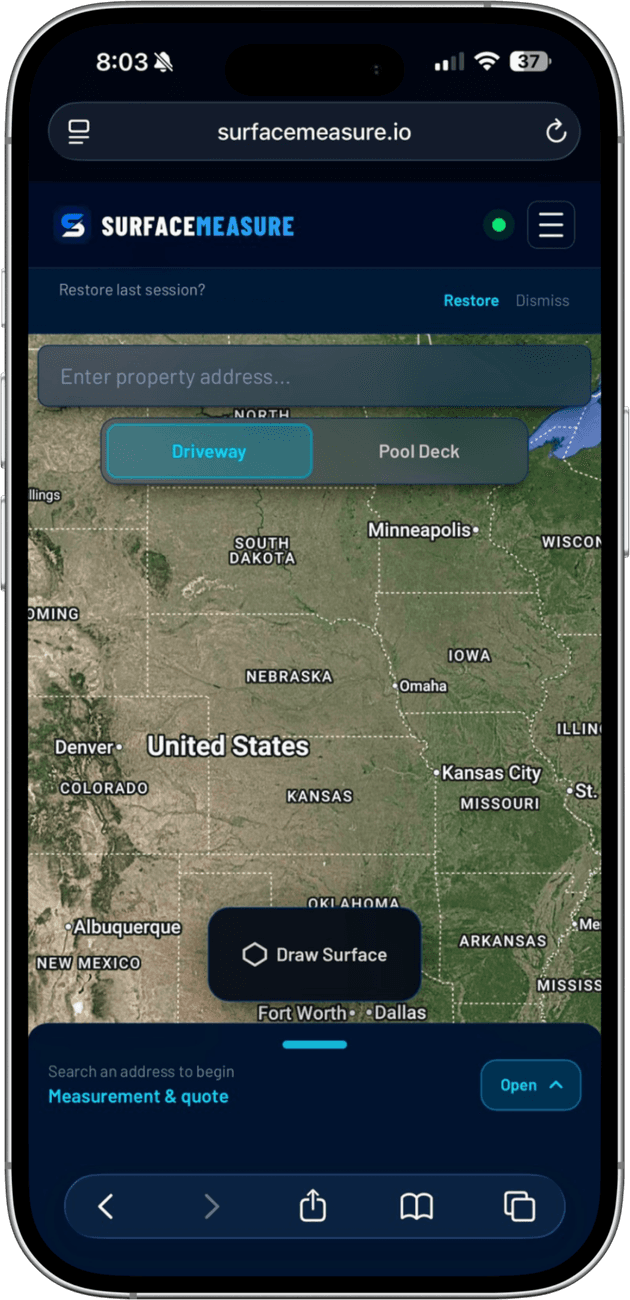
SurfaceMeasure is built for exactly this — measure any flat outdoor surface from satellite imagery before you ever drive to the property.
Search the Address
Pull up any property on satellite view. One session covers the entire property — driveway, deck, patio, and more.
Trace Each Surface
Use the polygon tool to outline each surface area. For pool decks, draw the deck perimeter and the pool separately — net area calculates automatically.
Get Square Footage Instantly
Each surface area calculates immediately. Add them up for total job size. Apply your rate and you have a quote — ready to send before you leave your desk.
Typical Market Rate Ranges
Once you have square footage, the rate you apply depends on your market, equipment, and the surface condition. The ranges below reflect typical industry rates for residential work — they vary by region and job complexity.
These are reference ranges only. Set your own rate based on your costs, local market, and minimum job floor — not an industry average.
Rates vary by region, surface condition, and equipment. Use as a reference only.
Pressure Washing Measurement — Common Questions
Practical answers for pressure washing contractors and estimators.
For a straight rectangular driveway, measure the length and width and multiply. Standard single-car driveways run 10–12 ft wide; double-car driveways run 18–24 ft wide. Don't forget the apron — the flared section where the driveway meets the street — which can add 200–400 sq ft depending on the property. For curved driveways, measure the center-line length and multiply by average width.
Measure the total area including the pool, then measure the pool surface separately and subtract. The result is the net washable deck area. Residential pool decks typically range from 600 to 1,200 sq ft net. You can also measure both in one session using SurfaceMeasure — trace the deck outline, then the pool outline inside it, and the net area calculates automatically.
For a rectangular patio, multiply length by width. For L-shaped patios, divide into rectangles, calculate each, and add. Exclude the footprint of large fixed furniture or built-in features you won't be moving. A typical residential patio ranges from 200 to 500 sq ft; large outdoor living spaces can reach 800 sq ft or more.
A single-car driveway typically runs 400–700 sq ft. A two-car driveway runs 800–1,500 sq ft. Wide aprons, turnarounds, or courtyard-style driveways can push the total to 2,000 sq ft or more. When quoting, always measure rather than estimating by the number of cars — driveway sizes vary more than most contractors expect.
Yes, for flat outdoor surfaces. SurfaceMeasure uses georeferenced satellite imagery — you trace the surface outline and get accurate square footage without driving to the property. This works for driveways, pool decks, and patios. Accuracy is typically within a few percent for flat surfaces, which is more than adequate for quoting. For multi-surface jobs, you can measure all areas in a single session.
Related Resources
Calculators and guides for pressure washing contractors.
Measure Any Surface Before the Job
Search the address, trace the surface, and get accurate square footage in under two minutes. Card required, cancel anytime.