
Paver Installation Cost Calculator
Square feet in; pavers, tons of base, sand, edging, the material bill and a price at your rate out. Free, no sign-up, and it shows what the job leaves for labor after the material.
Card required · Cancel anytime
Paver installation cost calculator: pavers, base, sand and job price
Area to pave
The job
Base is 5 in of compacted crushed stone for that use, on 1 inch of bedding sand, the ICPI convention. Stone is ordered at 1.15 for compaction and 1.10 for waste; a 50 lb bag of polymeric sand fills 75-100 sq ft of standard joints and 30-60 sq ft of wide ones.
Your material prices
2026 reference prices: concrete pavers $4-$6 per sq ft, brick $4-$8, natural stone $7-$16; crushed stone $20-$45 per ton, concrete sand $25-$40, polymeric sand $25-$80 per bag, plastic edge restraint $1-$3 per foot. Only the edge not held by a house, wall or curb needs restraint.
Your pricing
Installed, in 2026: concrete pavers $10-$20 per sq ft, brick $15-$30, natural stone $25-$50, driveways $15-$25. Labor alone runs $5-$11. Most installers carry a job minimum; set your own numbers.
Pavers to order
0pavers
0 sq ft + 10% waste = 0 sq ft of 6" × 9" pavers.
Price at your rate
$0
0 sq ft × $16.00 = $0
Length × width only works on rectangular sections. An L-shaped patio, a curved walkway or a driveway with a flare at the street is where the number drifts, and on a paver install a wrong area is wrong three times: pavers, base and price. Trace the real shape on satellite imagery and the area fills itself in.
Rectangles only. For an L-shaped patio, a curve or a driveway flare, the satellite tool below traces the real edge.
How the Calculator Gets Its Numbers
A paver takeoff is five multiplications, and every one of them starts from the area, which is why measuring it is the step worth getting right. Here is a 16 × 40 ft, two-car driveway in 6 × 9 in concrete pavers, herringbone, on a 10-inch base.
Pavers
area × (1 + waste) ÷ sq ft per paver
640 × 1.15 ÷ 0.375 = 1,963 pavers
Base stone
area × depth ÷ 12 ÷ 27, × 1.265, × 1.4 t/yd
640 × 10 ÷ 324 = 19.8 yd → 25.0 yd loose → 35 tons
Bedding sand
area ÷ 324, × 1.10, × 1.3 t/yd
640 ÷ 324 = 2.0 yd → 2.2 yd → 2.8 tons
Joint sand
area ÷ sq ft per bag
640 ÷ 85 = 8 bags
Price
area × your rate, or the minimum
640 × $20 = $12,800
At $5 a square foot for the pavers, $35 a ton for stone, $32 for sand, $30 a bag for polymeric and 80 feet of edge restraint at $2, that driveway carries $5,395 of material, $8.43 a square foot, and bills $12,800 at $20. The $7,405 left has to cover about 80 crew hours, the skid steer, the compactor, hauling 30 yards of spoil, overhead and profit. Price it at $15 and the same job leaves $4,200. That is why driveways sit at the top of the rate table, and why the material line in the calculator matters more than the headline price.
Base depth is the input to watch. A patio on 4-6 inches of stone is a very different order from a driveway on 8-12 inches, and clay or freeze-thaw ground wants the deep end of each. The full rate picture by paver and by use is on the paver cost per square foot page.
What Common Paver Jobs Take and Cost
6 × 9 in concrete pavers, running bond on patios and herringbone on driveways, a 5-inch base under patios and 10 inches under driveways. Stone is tons to order. Prices use $10-$20 per sq ft on patios and $15-$25 on driveways, installed. Use them as a sanity check on a number you just calculated, not as a quote.
| Job | Area | Pavers | Stone | Price |
|---|---|---|---|---|
| Front walkway120 sq ft | 120 sq ft | 352 | 3.3 t | at the minimum |
| Small patio, 12 × 14168 sq ft | 168 sq ft | 493 | 4.6 t | $1,700-$3,400 |
| Average patio280 sq ft | 280 sq ft | 822 | 7.7 t | $2,800-$5,600 |
| Large patio with a return500 sq ft | 500 sq ft | 1,467 | 13.7 t | $5,000-$10,000 |
| Single-car driveway480 sq ft | 480 sq ft | 1,472 | 26.2 t | $7,200-$12,000 |
| Two-car driveway, 16 × 40640 sq ft | 640 sq ft | 1,963 | 35.0 t | $9,600-$16,000 |
Excavation, spoil haul, fabric, a border course, steps and sealing are extra on every one of these. Just the paver count, at any size? The pavers square footage calculator does that alone.
Not a Rectangle? Measure It From Satellite
An L-shaped patio with a fire pit, a curved walkway or a driveway that flares at the street is where the tape and the guess both fail. Trace the real edge instead: address to square footage in under three minutes.
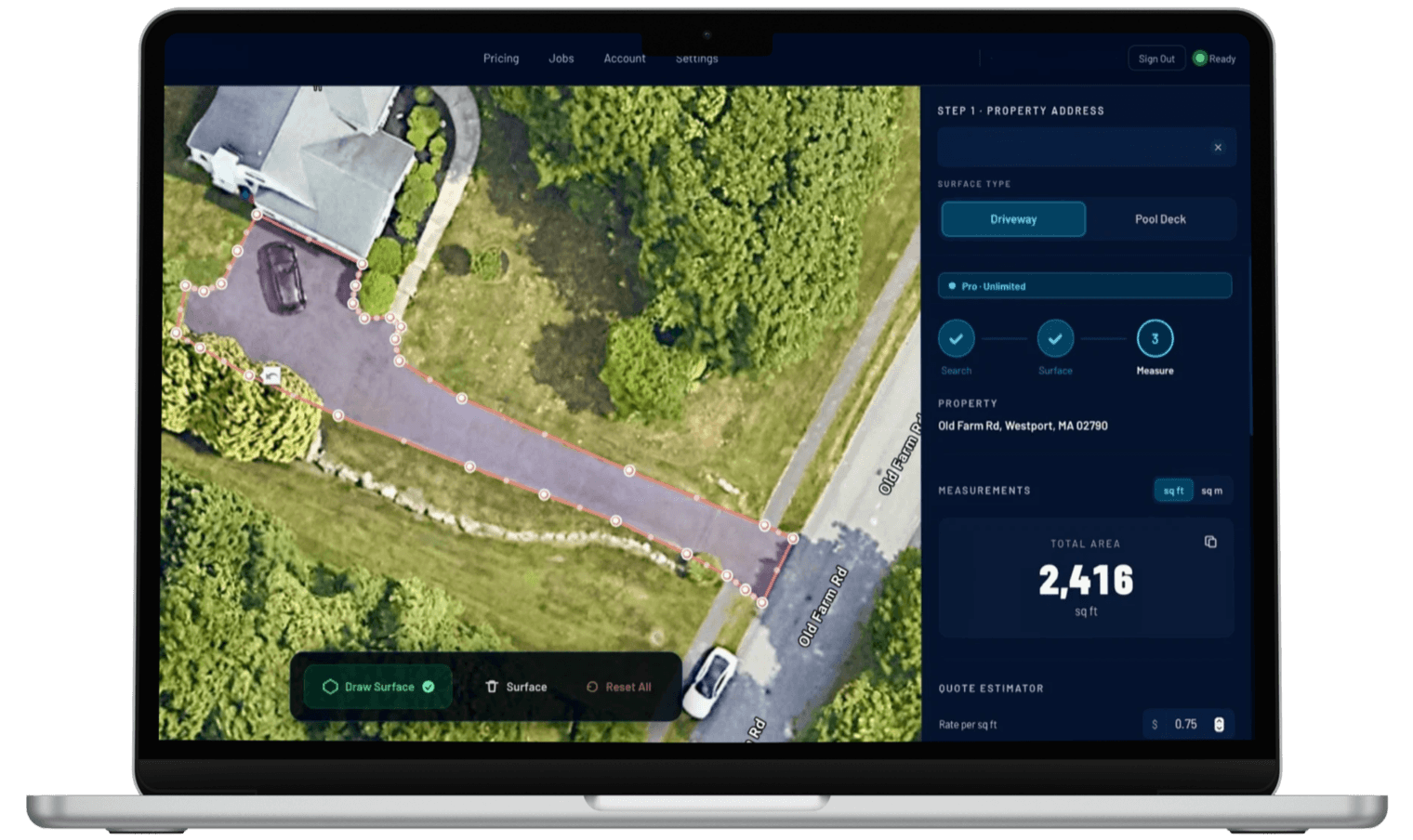
Search the address
Any property in the U.S. loads on satellite imagery: the back yard, the side gate, the driveway and the street it meets.
Trace the area
Click around the patio, or around the lawn the patio is going to replace. Draw the fire pit and the planters as cutouts so they come out of the order.
Price it as you draw
Set your installed rate once. The area, the price and a branded PDF quote are ready before you leave the office.
Where a Paver Estimate Goes Wrong
The calculator is only as good as its inputs. These four are the ones that turn a profitable install into a free one.
The area came from the customer
Homeowners describe the patio they want in paces and guesses. The order leaves the yard as pallets and tons of stone, so measure the footprint yourself before anything is ordered.
Patio base under a driveway
A car needs 8-12 inches of compacted stone and an 80 mm paver. Take a driveway off at a patio's 4-6 inches and you have underpriced the excavation, the stone, the haul and the compaction in one move.
Running-bond waste on a herringbone job
10% covers a grid. A herringbone or diagonal layout cuts along every edge and needs 15%. The shortfall arrives from a different production run, and paver colour lots do not match.
Material at retail on a big job
Bagged base and bagged sand cost several times the bulk price. Pallet pavers, stone by the ton and sand by the yard are what the installed rates assume; quote a 640 sq ft driveway on the price you will actually pay.
The rest of the bid, from the site visit to the labor line and how to present it, is in how to bid paver jobs.
Paver Calculator Questions
Base depth, waste, what the material bill covers, and what the price has to.
Measure the area, then take off five materials from it: pavers with a waste allowance, crushed stone for the base, bedding sand, polymeric joint sand and edge restraint. Pavers are area × (1 + waste) ÷ the square feet of one paver. Base is area × depth ÷ 12 ÷ 27 for cubic yards placed, ordered at about 1.27× for compaction and waste and weighing about 1.4 tons a yard. Add the labor hours, equipment and your margin, and check that total against area × your installed rate.
4-6 inches of compacted crushed stone under a patio or walkway and 8-12 inches under a driveway, with 1 inch of coarse concrete sand on top, which is the ICPI convention. A 280 sq ft patio on a 5-inch base takes about 5.5 cubic yards of loose stone, roughly 7.7 tons; a 640 sq ft driveway on 10 inches takes about 25 yards, 35 tons. Clay and freeze-thaw ground want the deep end of each range.
Your own. The calculator starts at an installed rate inside the 2026 ranges: concrete pavers $10-$20 per square foot, brick $15-$30, natural stone $25-$50, and driveways $15-$25 because of the deeper base and thicker paver. Labor alone runs $5-$11 per square foot. The full rate table and what moves a job inside it are on the paver cost per square foot page.
Because the pattern sets the waste. Running bond and simple grids cut pavers only at the border, so 10% on top of the net area covers it. Herringbone, diagonal and fan layouts cut at every edge and along every line, and 15% is the working allowance. On a 640 sq ft driveway the difference is about 85 pavers, which is the difference between finishing and waiting on a second pallet from a different colour lot.
It covers pavers, base stone, bedding sand, polymeric sand and edge restraint, which is most of the material bill. It does not include excavation and spoil haul, geotextile fabric, a border course in a second colour, steps or seat walls, sealer, or equipment rental. Those go on their own lines in the bid, and the calculator shows what the price leaves after material for exactly that reason.
Tracing a surface on satellite imagery typically lands within 1–3% of a tape measurement where the edge is visible. On a paver install the area drives three orders at once, pavers, base and sand, so a 5% miss on a 640 sq ft driveway is about 100 pavers and 1.7 tons of stone in whichever direction hurts. For an area that has not been built yet, trace the space it will go in.
The calculator on this page is free with no sign-up. The satellite measuring tool is part of Pro, with unlimited measurements, saved jobs and branded PDF quotes. New accounts start with a 7-day free trial of Pro: a card is required, nothing is charged today, and nothing at all if you cancel before the trial ends. After that it is $29.99 a month, or $299 a year (the yearly plan has no trial).
Paver Guides and Tools
The rate, the bid, and the count.
Measure the Patio Before You Order the Pallet
Search the address, trace the area, and price it at your rate. Card required, cancel anytime.