
Parking Lot Maintenance, Planned and Priced
Rate the lot. See ten years of crack sealing, sealcoat, striping and repair, priced year by year.
- Restripe 65 stalls$390
- Crack seal 550 ft$825
- Sealcoat, two coats$5,760
- Mill and overlay, 2 in$57,146
- Remove and rebuild$138,089
Sealcoat at $0.24 a sq ft, cracks at $1.50 a foot, stripes at $6 a stall; paving from 2025 state DOT unit bids. Change any of it in the planner.
How often should a parking lot be maintained?
Seal the cracks every year or two, sealcoat about every three years (SealMaster's interval), restripe after every coat, and re-rate the pavement every two years (the PASER manual's) so the overlay is planned, not discovered.
- Seal the cracks
- Every year
- Or every 1-2 years on inspection
- Sealcoat
- 3 years
- every 3 to 5 years in one owner's guideline
- Restripe
- Each coat
- The sealer covers the lines
- Re-rate the lot
- 2 years
- PASER: annually is better
Ten Years for Your Lot
Enter the pavement area, the stalls and the crack footage from the walk-through, then pick the condition. The planner books what the rating calls for this season and the preservation cycle after it, and prices every year. It opens on a 24,000 sq ft, 65-stall church lot sealed six years ago with moderate cracking, which reads as a 6.
Ten years: $32,850, $3,285 a year
Ten years
$32,850
A year
$3,285
Per sq ft a year
$0.137
This season
- Crack sealing$825
- Sealcoat$5,760
- Restripe$390
- NowCrack sealingSealcoatRestripe$6,975
- Yr 2Crack sealing$825
- Yr 3Crack sealing$825
- Yr 4Crack sealingSealcoatRestripe$6,975
- Yr 5Crack sealing$825
- Yr 6Crack sealing$825
- Yr 7Crack sealingSealcoatRestripe$6,975
- Yr 8Crack sealing$825
- Yr 9Crack sealing$825
- Yr 10Crack sealingSealcoatRestripe$6,975
Any address.
Your prices and intervals
Sealcoat on a lot this size runs $0.17-$0.30 a sq ft; crack sealing $0.50-$3.00 a foot; restriping $5-$10 a stall. SealMaster recommends sealcoating every 3 years; one large lot owner's guideline says every 3 to 5 years. Overlays and rebuilds are priced from 2025 state DOT unit bids on the paving calculator. Patching is priced as remove and replace.
The plan schedules nothing structural after this season: no source puts the next overlay in years, so it doesn't guess one. Re-rate every two years and run it again.
The Same Ten Years, From Three Conditions
The 24,000 sq ft, 65-stall lot, planned three times. Everything after this season is the same cycle; what changes is what the pavement needs first.
6
Good
Crack sealing, sealcoat and stripes
$32,850
4
Fair
A 2 in structural overlay first
$73,785
2
Very poor
Remove and rebuild first
$163,529
The PASER manual's warning is the reason the gap matters: once significant deterioration begins, it says, pavement commonly declines rapidly. Crack sealing and sealcoat are what it credits with slowing the moisture that drives it.
Rate the Lot: the PASER Scale
The rating many cities and counties use to plan asphalt work, from the University of Wisconsin-Madison's Transportation Information Center. Walk the lot, match what you see, and the rating tells you the treatment. The “needs” column is the manual's own words.
10
Excellent
Looks like: None.
Needs: New construction.
9
Excellent
Looks like: None.
Needs: Recent overlay. Like new.
8
Very good
Looks like: Transverse cracks 40 ft or more apart; all cracks sealed or tight (open less than 1/4 in).
Needs: Recent sealcoat or new cold mix. Little or no maintenance required.
7
Good
Looks like: Cracks open about 1/4 in, 10 ft or more apart; very slight raveling.
Needs: First signs of aging. Maintain with routine crack filling.
6
Good
Looks like: Slight raveling; cracks 1/4 to 1/2 in open; the first block cracking.
Needs: Shows signs of aging. Sound structural condition. Could extend life with sealcoat.
5
Fair
Looks like: Moderate to severe raveling; cracks 1/2 in or more; block cracking up to 50% of the surface.
Needs: Surface aging. Sound structural condition. Needs sealcoat or thin non-structural overlay (less than 2").
4
Fair
Looks like: Block cracking over 50% of the surface; ruts up to 1/2 in.
Needs: Significant aging and first signs of need for strengthening. Would benefit from a structural overlay (2" or more).
3
Poor
Looks like: Some alligator cracking, less than 25% of the surface; ruts 1/2 to 2 in; occasional potholes.
Needs: Needs patching and repair prior to major overlay. Milling and removal of deterioration extends the life of overlay.
2
Very poor
Looks like: Alligator cracking over 25% of the surface; ruts 2 in or more.
Needs: Severe deterioration. Needs reconstruction with extensive base repair. Pulverization of old pavement is effective.
1
Failed
Looks like: Severe distress with extensive loss of surface integrity.
Needs: Failed. Needs total reconstruction.
9-10: No maintenance required
8: Little or no maintenance
7: Routine maintenance, cracksealing and minor patching
5-6: Preservative treatments (sealcoating)
3-4: Structural improvement and leveling (overlay or recycling)
1-2: Reconstruction
One Lot, Four Flights
The same parking field in Pineville, NC, photographed straight down by the state's mapping flights. Part of a lot's condition shows from above before anyone drives out: faded paint, gray oxidized asphalt and patches. The cracks the rating counts need the walk-through.
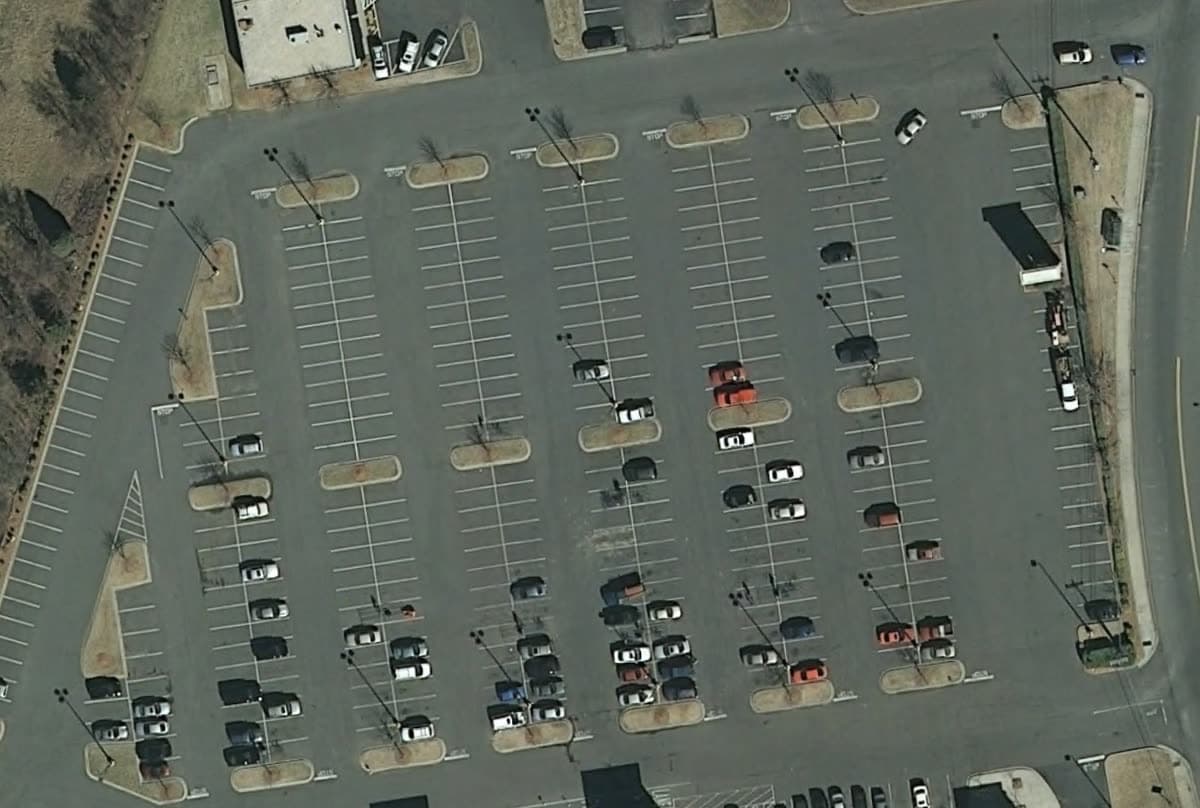
2010Striped, the pavement gray. The 2010 flight is coarser than the others. 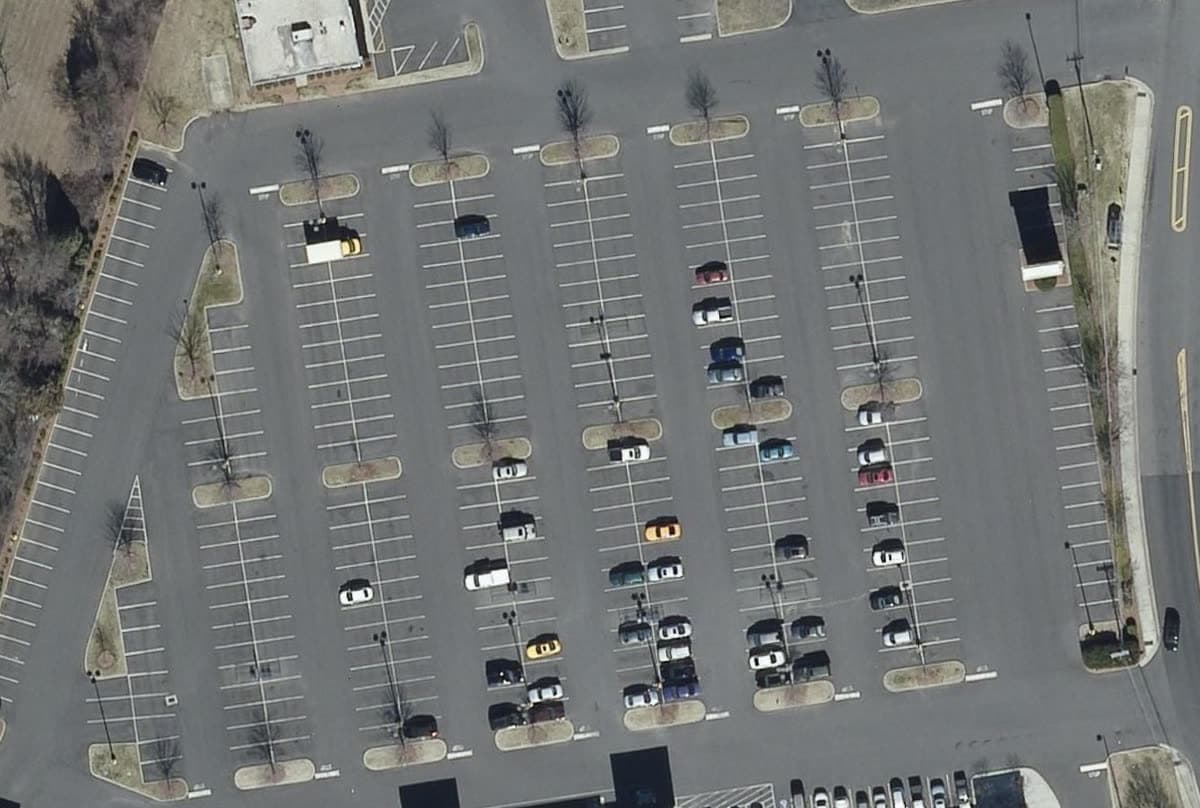
Feb 2015Bright stall lines on gray pavement. 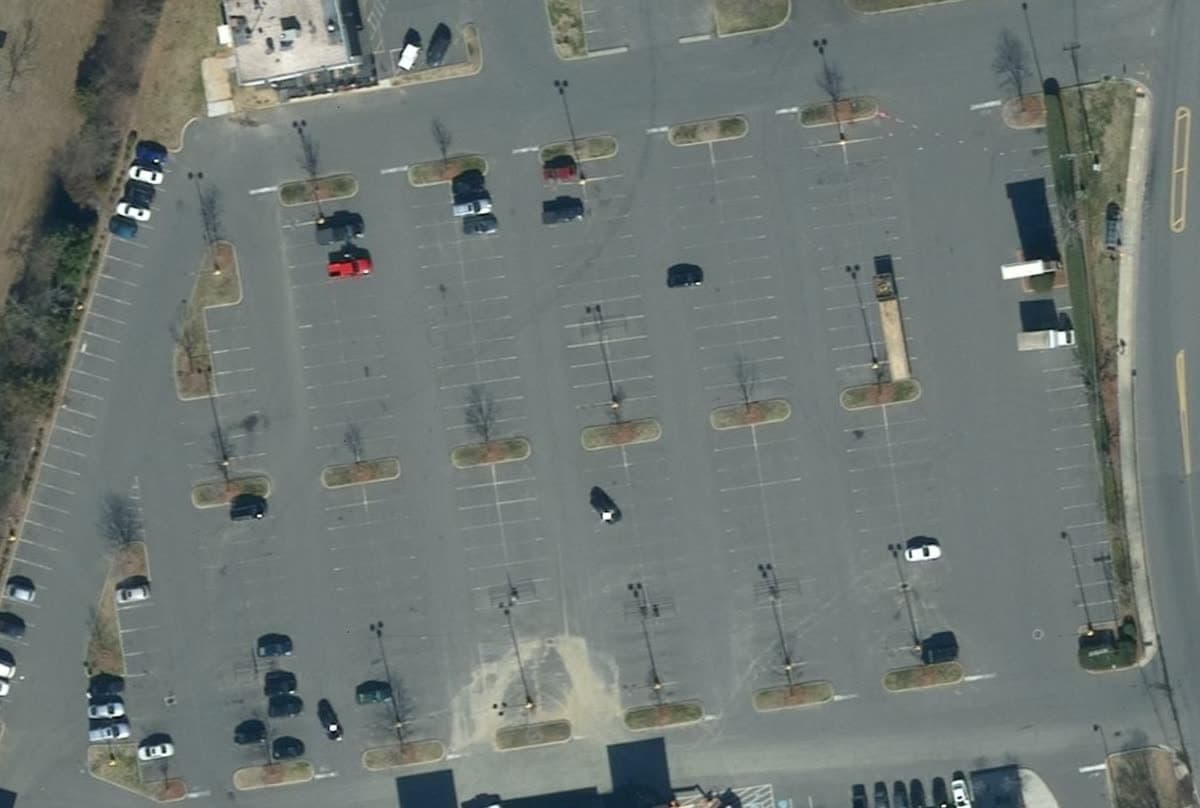
Feb 2019Four winters on, the lines are faint ghosts. A pale patch near the bottom. 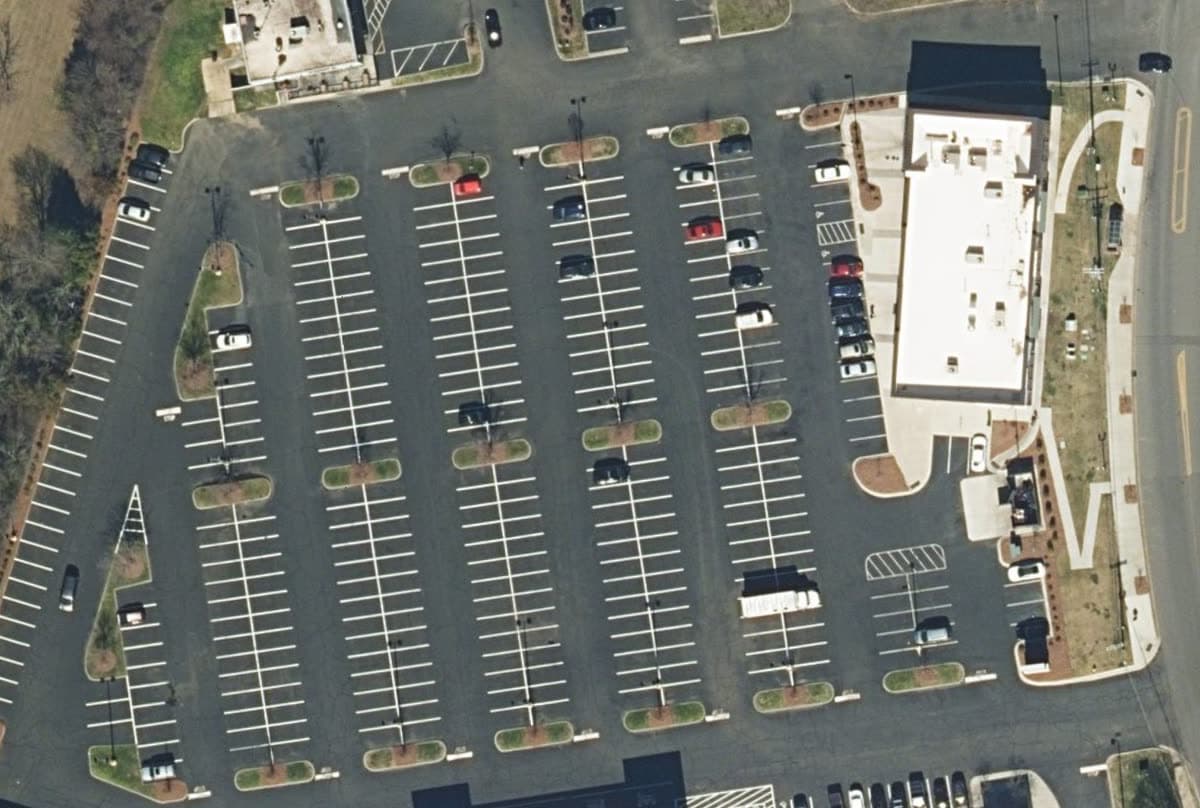
Feb 2023Black pavement, every line repainted in a new layout, a new building on the east side.
Imagery: NC OneMap, flights of 2010, February 14 2015, February 1 2019 and February 18 2023. The photos cannot show whether the lot was sealed or repaved, or when; they show what each flight saw.
Asphalt Pavement Maintenance, Treatment by Treatment
| Treatment | When | How often | Price |
|---|---|---|---|
| Crack sealing | As soon as working cracks open, in spring or fall | Every year, or every 1-2 on inspection | $0.50-$3.00 a foot |
| Sealcoat | A 5 or 6; first coat 12 to 18 months after paving | every 3 years (SealMaster), every 3 to 5 years (one owner's guideline) | $0.17-$0.30 a sq ft on a lot this size |
| Restripe | After every coat, 24 hours after the sealer | With each coat; about every 18 to 24 months by Asphalt Kingdom's count | $5-$10 a stall |
| Overlay, 2 in | A 4: block cracking over half the surface | Once, then back to the sealcoat cycle | $48,345 on the example lot |
| Rebuild | A 1 or 2: alligator cracking over a quarter of the surface | Once, then start the cycle again | $138,089 on the example lot |
Thin overlays under 1.5 in are a preservation treatment, not a structural one: they added 5 to 12 years of life in FHWA's state data, but FHWA says they are not intended to add structural capacity, and a lot with fatigue cracking needs more than a surface. That is why the scale sends a 4 to a 2 in structural overlay and a 3 to patching and milling first.
Sell the Plan, Not Just the Coat
A property manager budgets by the year. Hand them this season's work and the next nine, priced, and the sealcoat stops being a one-off bid against every other bid. It becomes the first line of a plan with your name on it.
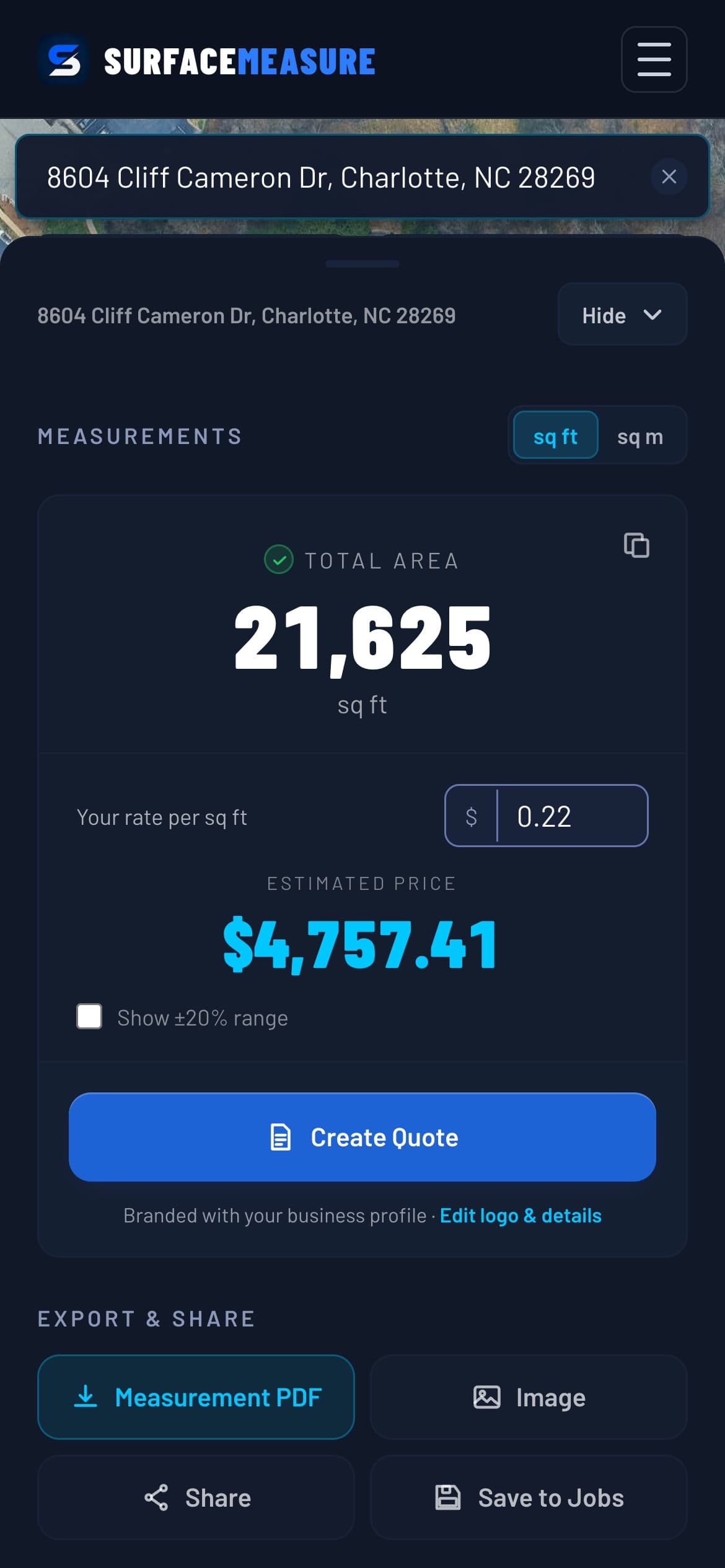
- Measure before you drive out. Search the address in SurfaceMeasure and trace the pavement on satellite imagery: the area every line here rides on.
- Rate it on the walk-through. Crack footage with a wheel, the PASER rating by eye.
- Quote this season, attach the rest. Sealcoat on the measured square feet, cracks and stripes as their own lines, sent as a quote the manager accepts online; the copied plan goes in the same email.
Card required · Cancel anytime
“$1 Now Saves $6 to $10 Later,” Traced
Every pavement maintenance pitch quotes it. The figure most of them trace back to is an example curve in TRB's TR News (Galehouse, Moulthrop and Hicks, 2003): a pavement that loses 40% of its quality over 75% of its life, and a dollar of preservation that “eliminates or delays spending $6 to $10 on rehabilitation or reconstruction.” The figure is labeled an example and cites no data.
The agency numbers are real, and smaller or different in kind. In the same issue Caltrans reported that $1 of preventive maintenance can save $6 of rehabilitation and $20 of reconstruction, if applied at the right time. Michigan DOT, as reported in FHWA's 2003 pavement preservation compendium, found rehabilitation and reconstruction projects cost about 10-14 times as much as preventive maintenance per lane mile.
Those are highway networks. For one lot the honest version is to price both, which the planner does: on the example lot, a round of crack sealing, sealcoat and stripes is $6,975; a mill and overlay is $57,146.
Maintenance Questions
Inspect and rate it every year or two, seal the cracks every year or two, sealcoat about every three years and restripe after every coat. SealMaster recommends sealcoating every 3 years; the Church of Jesus Christ of Latter-day Saints' facilities guideline says every 3 to 5 years and cracks annually. The PASER manual recommends re-rating every two years, and says an annual update is better.
It depends on the lot's size and condition. A 24,000 sq ft, 65-stall lot in good structural condition costs $6,975 for one round of crack sealing, sealcoat and restriping, and about $32,850 over ten years at that pace, $3,285 a year. The same lot needing a structural overlay first is about $73,785 over the same ten years.
It depends on the repair. Crack sealing runs $0.50-$3.00 a linear foot; digging out failed areas and patching them (remove and replace) is quoted to owners at $4-$10 a sq ft; a mill and overlay of the whole lot at $1-$3 a sq ft. On the 24,000 sq ft, 65-stall example lot, a mill and overlay prices at $57,146 from 2025 state DOT unit bids, against $6,975 for a round of crack sealing, sealcoat and stripes. The PASER rating says which one the lot needs.
SealMaster recommends every 3 years, sooner in hard winters and with a third coat in high traffic. The Church of Jesus Christ of Latter-day Saints' facilities guideline says every 3 to 5 years with emulsion sealers, the first seal 12 to 18 months after the lot is paved.
Annually, by the Church of Jesus Christ of Latter-day Saints' facilities guideline, for every crack wider than 1/8 inch; every 1-2 years based on inspection, by the Indian Health Service's facilities guidance. FHWA's crack seal manual says to seal working cracks shortly after they appear, in spring or fall at 7 to 18°C. On new pavement, thermal cracks appear 2 to 7 years after construction.
After every sealcoat, because the coat covers the lines; SealMaster says to let the sealer cure 24 hours before the paint goes on. Between coats it depends on traffic and plows: Asphalt Kingdom puts it about every 18 to 24 months, and yearly in snow country.
On the PASER scale, a 5 or 6 is structurally sound and needs sealcoat; a 4, with block cracking over half the surface, would benefit from a structural overlay of 2 inches or more; a 3 needs patching and milling before a major overlay. Once alligator cracking covers more than 25% of the surface (a 2), the manual calls for reconstruction.
PASER (Pavement Surface Evaluation and Rating) is a 1-to-10 visual rating of asphalt from the Transportation Information Center at the University of Wisconsin-Madison. You walk the pavement, match what you see (cracks, raveling, ruts, alligator cracking) to the manual's descriptions, and each rating comes with the treatment it calls for: 10 is new, 1 has failed.
The agencies say so; the numbers behind the famous ratio are thinner than they look. The "$1 now saves $6 to $10 later" line comes from an example curve in TR News (2003) that cites no data. Caltrans reported $1 of preventive maintenance saving $6 of rehabilitation and $20 of reconstruction, and Michigan DOT, in FHWA's 2003 compendium, found rehabilitation and reconstruction cost 10-14 times as much as preventive work per lane mile. On a single lot the check is simpler: price both. On this page's example lot, a mill and overlay is $57,146; a round of sealcoat, cracks and stripes is $6,975.
Sources
Read from the documents themselves in October 2026. Prices are the site's published reference ranges and state DOT unit bids; your own costs set your price.
- Transportation Information Center, UW-Madison: Asphalt PASER ManualThe 1-10 rating, each rating's distress and treatment, re-rating every two years. 2002, revised 2013.
- SealMaster: How Often Should You Sealcoat a Parking Lot or Driveway?Sealcoat every 3 years; sooner in harsh winters; a third coat in high traffic.
- The Church of Jesus Christ of Latter-day Saints, AEC: Asphalt Paving Maintenance Strategy and Preservation GuidelinesSeal every 3-5 years, first seal 12-18 months after paving, cracks annually, spring or fall. March 2015.
- FHWA-RD-99-147: Materials and Procedures for Sealing and Filling Cracks in Asphalt-Surfaced PavementsSeal working cracks shortly after they appear; spring or fall; when thermal cracks appear. 1999.
- Indian Health Service: Asphalt Preservation SolutionsCrack sealing every 1-2 years based on inspection. January 2014.
- FHWA-HIF-19-053: The Use of Thin Asphalt Overlays for Pavement PreservationLife extension of thin overlays by state; not structural. June 2019.
- TRB, TR News 228: Principles of Pavement Preservation; Caltrans preventive maintenanceThe example pavement option curve, and Caltrans' savings per dollar. September-October 2003.
- FHWA-IF-03-21: Pavement Preservation CompendiumRehabilitation and reconstruction against preventive maintenance, per lane mile. September 2003.
- Asphalt Kingdom: When to Restripe Parking Lot?Sealcoat covers the lines; restripe about every 18-24 months, yearly with plows. September 2025.
- SealMaster: Acrylic Traffic Paint, SMT-240Let fresh sealer cure 24 hours before striping. June 2020.
- NC OneMap: statewide orthoimagery, 2010-2023 flightsThe four aerials of one lot. Free and unrestricted use.
Quote This Season. Keep the Lot.
Measure it from satellite, quote this season's work, and hand over the plan for the rest.
Start 7-Day Free TrialCard required · Cancel anytime