
Parking Lot Line Painting
How to lay out and stripe a lot to spec, and how much paint it takes before you load the truck.
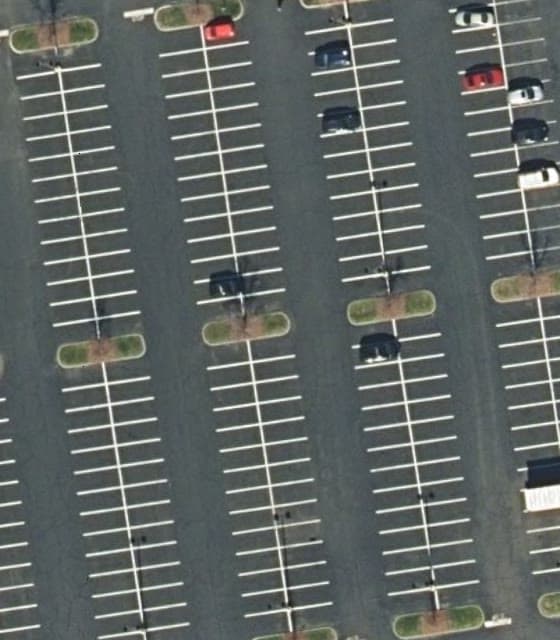
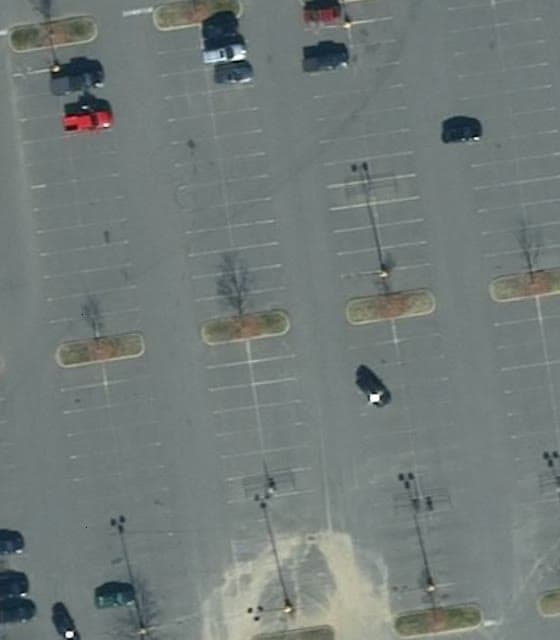
One lot in Pineville, NC, from two flights over the same ground. Imagery: NC OneMap.
How do you paint parking lot lines?
Clean the pavement, lay out from a reference line at stall depth, dot each stall and stripe at 15 mils wet on a dry day above 50°F. At that film a gallon stripes about 320 ft of 4 in line: Sherwin-Williams prints 320, SealMaster 325.
- Standard stall line
- 4 in
- 4 to 6 in is the normal line
- Wet film
- 15 mils
- What coverage is written for
- Of 4 in line a gallon
- 320 ft
- About 107 sq ft at that film
- And rising
- 50°F
- Air and pavement
- After sealcoat
- 24 hours
- 4 weeks on new asphalt
How Much Paint to Stripe a Lot
Enter the lot and it lays out the rows, counts the stall line it will take and turns it into gallons at your width, film and coats. It opens on a 300 × 200 ft lot: 168 stalls, 3,636 ft of line, about 11 gallons for one coat.
The lot
The paint
Waterborne traffic paint runs $35-$50 a gallon. At 15 mils a gallon spreads 321 ft of 4 in line.
11 gallons for 3,636 feet of line
Paint
11gal
$476 of paint · 3 five-gallon pails
Line to paint
3,636ft
168 stalls in 6 rows
- Accessible spaces (ADA)
- 6, 1 van
- A gallon covers
- 321 ft of 4 in line
Real lots have islands, entrances and odd corners. Measure the real one and quote the striping on the same visit as the sealcoat.
Measure the real lot from satelliteAny address.
Stall line only, with the head line where 90° rows back onto each other: symbols, arrows, stop bars and crosswalks come on top. Layout from SUDAS stall and aisle modules on a clean rectangle with drive lanes at both ends. Coverage is the theoretical figure the makers print; porous pavement drinks more.
How to Stripe a Parking Lot
Eight steps, from the weather check to opening the rows, written from the paint makers' data sheets and Graco's layout manual.
Pick a day the paint can cure
Sherwin-Williams and SealMaster both set the floor at 50°F, and SealMaster adds that it should not drop below that for the next 24 hours. Sherwin-Williams also wants the surface at least 5°F above the dew point and humidity under 85%. Over fresh sealcoat, SealMaster says wait at least 24 hours. On new asphalt it says 4 weeks, until the surface oils are gone; Sherwin-Williams says several months, and if the lot cannot wait, no more than 8 mils wet.
Clean every line you will paint
Sweep, then blow out the line work. Sherwin-Williams' data sheet is plain about it: the surface must be clean, dry and in sound condition, with all oil, dust, grease and dirt removed to ensure adequate adhesion. SealMaster's asks for pavement clean and free of loose material and dirt.
Follow the old lines, or black them out
Sherwin-Williams says most painted lines can be repainted with no other prep as long as the old paint is still tightly adhered, and warns that layer on layer eventually peels. A restripe follows the old lines. A new layout starts by blacking the old ones out: SealMaster makes a block-out paint for exactly that, so the old stalls do not ghost through the new ones.
Set a reference line at stall depth
Graco's layout manual starts every row the same way: a dot at the start and a dot at the finish, each one stall depth off the curb (18 ft in its example and on the standard stall). A string line and chalk between them is the traditional way, and Graco notes that it takes two people.
Divide the run into stalls and dot each one
Measure the run and divide it into whole stalls, then let the width fall where it falls: Graco's example takes 144.48 ft as 16 stalls of 9.03 ft. Widths are measured line center to line center, which is how the ADA Standards measure accessible spaces (502.1). Check the city's stall size on the parking space dimensions page before the first dot.
Paint the lines at full film
Connect the dots with the striper at 15 mils wet, the film both makers write their coverage for: Sherwin-Williams prints 320 ft of 4 in line a gallon, SealMaster 325. SealMaster's sheets run an airless rig at 2,000-2,500 psi on a .021-.025 in tip. Where the code wants hairpins, the two lines go 12 in apart.
Mark the accessible spaces, stop bars and fire lanes
The ADA requires the access aisle to be marked so as to discourage parking in it, and leaves the method and color to state and local rules (502.3.3); the symbol it requires is on the sign, 60 in up to the sign's bottom (502.6). The federal manual adds the pavement symbol in each accessible space, at 28 in tall in FHWA's standard drawing, and stop lines 12 to 24 in wide in white. Fire lanes follow the local fire code: see the rules below.
Keep cars off until it is dry
Cone the rows until the paint is dry to no pick-up: 60 minutes for Sherwin-Williams' waterborne paint at 15 mils, 77°F and 50% humidity, under 30 minutes for SealMaster's acrylic, under 6 minutes for its fast-dry. Cooler, damper days run longer.
Feet of Line per Gallon
A US gallon is 231 cubic inches. Spread one mil thick, that is 1,604 sq ft; at 15 mils, about 107. Divide by the line's width in feet and you have the feet of line a gallon paints. Sherwin-Williams prints the same 107 sq ft on its data sheet.
| Wet film | 4 in line | 5 in line | 6 in line |
|---|---|---|---|
| 15 milsthe standard film | 321 ft | 257 ft | 214 ft |
| 12 milsthin coat | 401 ft | 321 ft | 267 ft |
| 8 milsnew asphalt, at most | 602 ft | 481 ft | 401 ft |
Two coats is twice the paint, and a wider line costs in proportion: a 6 in line takes half again what a 4 in line does. Waterborne traffic paint runs $35-$50 a gallon, so on the 300 × 200 ft lot one coat is about 11 gallons of material.
Aerosol is for touch-ups and small lots. Rust-Oleum's data sheet gives 275-300 ft of 3 in line from an 18 oz can, so the 3,636 ft on that lot would be 13 cans or more.
Parking Lot Striping Standards: Who Sets the Rules
The federal traffic manual is the obvious reference for pavement markings, but its own Section 1B.01 says it does not apply to parking lots. Four sets of rules do, and the local ones win.
- Federal traffic manual (MUTCD)
- A reference in a parking lot, not the law. Its own Section 1B.01 says it does not apply to parking areas, public or private. Its normal line is 4 to 6 in, stop lines 12 to 24 in, arrows and words white.
- ADA Standards
- Accessible spaces 96 in wide for a car and 132 in for a van, measured from line centers; access aisles marked so nobody parks in them, method and color left to local rules; the symbol on a sign 60 in up.
- City zoning code
- Stall width and length, aisle widths, line width and color, hairpins. It varies city to city: seven codes side by side are on the parking space dimensions page.
- Local fire code
- Fire lanes. The model code leaves the marking to the fire official: Lubbock, TX wants a 6 in red stripe lettered "FIRE LANE NO PARKING" in 4 in white every 40 ft; Tukwila, WA paints the curb yellow.
Stall sizes by city: parking space dimensions. How many accessible spaces a lot needs: ADA parking requirements.
Bid the Lot Before You Drive Out
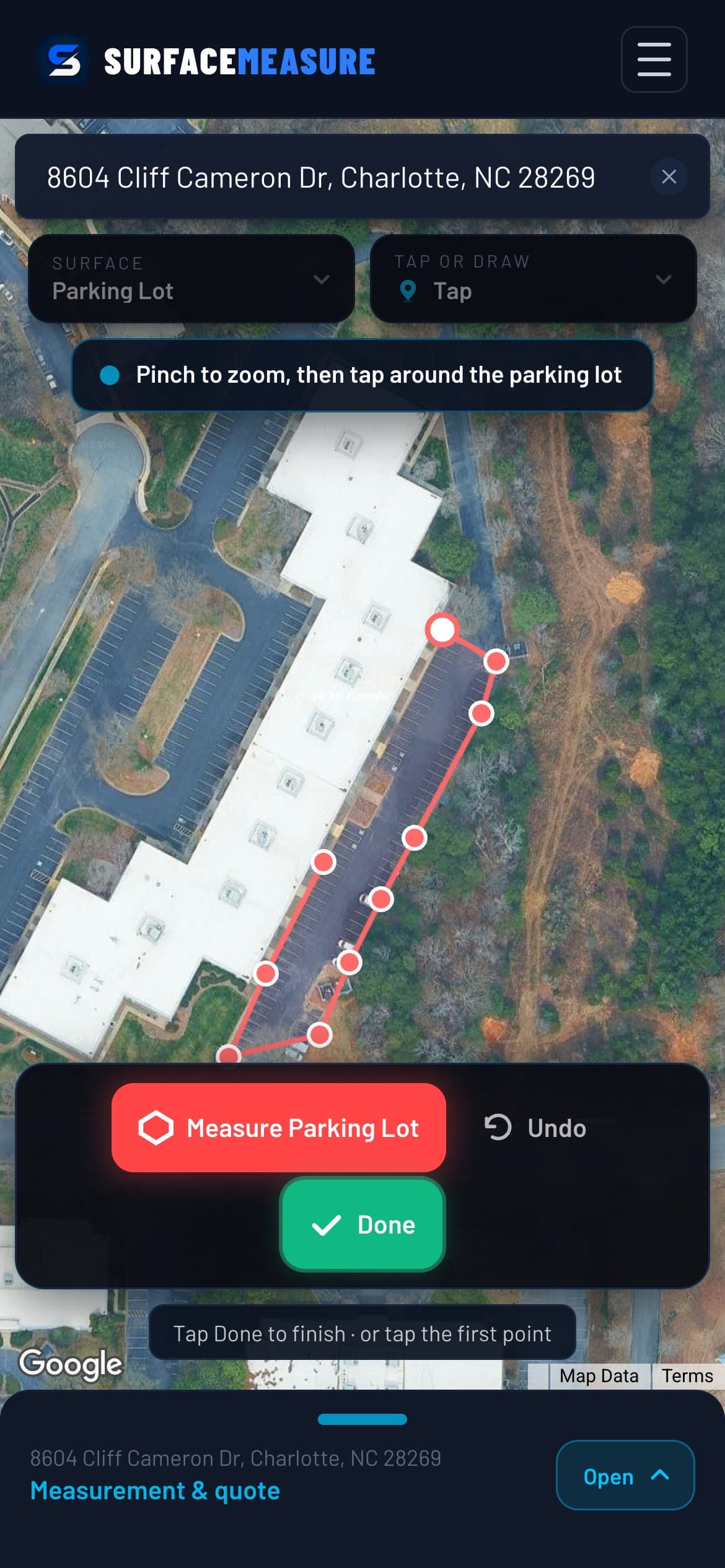
Striping often goes out on the same visit as the sealcoat, and that line is priced by the square foot. Search the address in SurfaceMeasure, trace the pavement on satellite imagery, and the area is measured; count the stalls on the same imagery while you are there.
Then put the striping on the quote as its own line, stalls times your price, next to the sealcoat. Contractors restripe at $5-$10 a stall; the full bid math is on the striping cost page.
Start 7-Day Free TrialCard required · Cancel anytime
Line Painting Questions
A gallon of traffic paint covers about 107 sq ft at 15 mils wet, which is about 320 ft of 4 in line. A 300 × 200 ft lot holds 168 standard stalls at 90 degrees, about 3,636 ft of stall line, so one coat is about 11 gallons, or 3 five-gallon pails. Symbols, arrows and stop bars come on top.
Sherwin-Williams prints about 320 ft of 4 in stripe a gallon and SealMaster 325 ft, both at 15 mils wet. At 12 mils, SealMaster's low-VOC sheet gives 400 ft. The arithmetic: a gallon is 231 cubic inches, so it covers 1,604 sq ft at 1 mil and about 107 sq ft at 15.
SealMaster says to let fresh pavement sealer cure at least 24 hours before traffic paint goes on. New asphalt needs longer: 4 weeks for the surface oils to leave by SealMaster's sheets, several months by Sherwin-Williams', which says that if it must be painted sooner, apply no more than 8 mils wet.
Dry to no pick-up, at 15 mils: 60 minutes for Sherwin-Williams' waterborne traffic paint at 77°F and 50% humidity, under 30 minutes for SealMaster's acrylic and under 6 minutes for its fast-dry formula. Cold and humidity slow every one of them.
50°F and rising for waterborne traffic paint: Sherwin-Williams also wants the surface 5°F above the dew point and humidity under 85%, and SealMaster says the temperature should not fall below 50°F within 24 hours. SealMaster's low-VOC paint goes down at 40°F, and Rust-Oleum's aerosol striping paint above 32°F.
Yes, if the old paint is still tightly bonded: Sherwin-Williams says most painted lines can be repainted with no other surface prep. It also warns that layer on layer eventually peels and has to come off. If the layout is changing, black the old lines out first so they do not show through.
Rust-Oleum's data sheet for its 18 oz inverted striping can gives 275-300 ft of 3 in line a can. That suits a small lot or a touch-up; the 3,636 ft on a 168-stall lot is 13 cans or more, which is a job for a striper and pails.
Sources
Every figure on this page, read from the documents themselves in October 2026. The paint you buy has its own data sheet: it wins.
- Sherwin-Williams: Setfast Waterborne Traffic Marking Paint (red, blue, black), PDS 123.08Coverage at 15 mils, dry time, temperature, surface prep, new asphalt, repainting over old lines. July 2021.
- SealMaster: Acrylic Traffic Paint, SMT-240Feet of 4 in line a gallon, film, dry time, temperature, waiting on new asphalt and fresh sealer. June 2020.
- SealMaster: Fast-Dry Traffic Paint, SMT-244Coverage and dry time of the fast-dry formula. June 2020.
- SealMaster: Line Block-Out Paint, SMT-245Blacking out old lines before a new layout.
- Rust-Oleum: 2300 System Inverted Striping Paint, TDS GDH-1089Feet of line an 18 oz can, line width, temperature.
- FHWA: Manual on Uniform Traffic Control Devices, 11th Edition, Part 1Section 1B.01: the manual does not apply to parking areas, public or private. December 2023.
- FHWA: Manual on Uniform Traffic Control Devices, 11th Edition, Part 3Line widths, stop lines, word and arrow markings, the accessibility symbol, crosswalks. December 2023.
- FHWA: Standard Highway Signs, Pavement MarkingsDimensions of the accessibility symbol. 2004 edition with the 2012 supplement.
- U.S. Access Board: 2010 ADA Standards, Chapter 5502.1, 502.2, 502.3 and 502.6: space and aisle widths, aisle marking, signs.
- Graco: Parking Lot Layout for LineLazer V HP Auto Series, 3A8102AReference dots at stall depth, dividing a run into stalls.
- City of Lubbock, TX: Fire Lane Marking RequirementsStripe, lettering and spacing for a marked fire lane.
- City of Tukwila, WA: Fire lane ordinanceYellow curb marking, the counter-example.
- NC OneMap: statewide orthoimagery, 2019 and 2023 flightsThe aerials at the top of this page. Free and unrestricted use.
Measure It. Stripe It. Quote It.
Trace the lot from satellite, price the sealcoat by the square foot and the striping by the stall, and send one quote the manager can accept online.
Start 7-Day Free TrialCard required · Cancel anytime