Snow Plow Insurance for Commercial Lots

The cover a snow contractor carries, what property managers require, and the costs insurance agencies publish.

Start 7-Day Free TrialCard required, cancel anytime.

What one commercial snow RFP asked for

Workers' compensation
Statutory
Employer's liability
$1,000,000
Commercial general liability
$1,000,000 per occurrence, $2,000,000 aggregate
Auto liability, hired, owned and non-owned
$1,000,000 per occurrence
Also
Named additional insured on general liability and auto, a signed certificate before any work, the same cover from every subcontractor.
Western Trade Center, Missoula, MT. Issued July 24, 2026 by Washington Corporations' Facilities Department.

Snow Plow Insurance, in Short

Snow plow insurance is the set of business policies a snow contractor carries: general liability with an endorsement that covers plowing with a truck, commercial auto for the truck and its plow, and workers' comp once you hire. Contracts add hired and non-owned auto, equipment cover or an umbrella. Commercial property managers usually ask for $1 million per occurrence, a certificate before the first push, and to be named additional insured.

General liability
$132 a monthInsureon's published figure for snow removal contractors.
Commercial auto
$299 a monthInsureon's figure for landscaping companies, snow contractors included.
Usual contract ask
$1 millionPer occurrence, with the owner named additional insured. Missoula adds $2 million aggregate.
Personal auto
Not enoughProgressive: personal policies typically do not cover business use.

General information for contractors, not insurance or legal advice. SurfaceMeasure is measuring and quoting software and sells no insurance. What a policy covers is in its wording, and the rules differ by state, so confirm everything with a licensed agent and have an attorney read your contracts.

Snow Removal Liability Insurance and the Policies Around It

Commercial customers usually require general liability, SIMA says, and on a snow lot the claim it answers is the fall after a storm. The rest of the list follows from what you drive, who works for you and what the contract says.

General liability

Bodily injury and property damage your business is found liable for, which on a commercial lot means the slip-and-fall claim filed after a storm.

On a commercial lot: Customers usually require it. Read the exclusions for a snow and ice removal exclusion before you sign anything.

SIMA, Progressive Commercial

Snow plow endorsement (CG 22 92)

An unendorsed general liability policy excludes injury and damage from autos. SIMA names CG 22 92, the Snow Plow Completed Operations endorsement, as the form that covers an auto used for plowing.

On a commercial lot: Carriers word this differently, so ask your agent which form yours uses for plowing with a truck.

SIMA

Additional insured, ongoing and completed operations

CG 20 10 extends your policy to the owner or manager while you work; CG 20 37 keeps it there for claims that come after the job is done.

On a commercial lot: SIMA says most snow contracts require both. Every additional insured shares your limit instead of adding to it.

SIMA

Commercial auto, plow included

Liability and physical damage for the work truck and the plow permanently attached to it.

On a commercial lot: Personal auto typically does not cover business use, and a car scraped in a client's lot is a business claim.

Progressive Commercial, NEXT

Hired and non-owned auto

Liability when a rented, borrowed or subcontracted truck is plowing on your behalf.

On a commercial lot: If a subcontractor crashes on your contract, you could be held responsible. The Missoula RFP asks for hired, owned and non-owned autos.

SIMA, The Washington Companies

Tools and equipment (inland marine)

Spreaders, pushers, blowers and the gear that leaves your yard, when it is stolen or damaged.

On a commercial lot: Items worth more than $2,500 may need to be listed one by one, so bring the serial numbers.

SIMA, Insureon

Workers' comp and employer's liability

Injuries to your own crew, including lost wages. SIMA calls it mandatory once you have employees; when your state requires it is set by its own workers' comp board.

On a commercial lot: Commercial RFPs list it as statutory, with employer's liability beside it.

SIMA, The Washington Companies, U.S. Department of Labor

Umbrella or excess liability

Extra liability over general liability and auto, sold in layers. A follow-form policy takes the terms of the policy under it.

On a commercial lot: SIMA says larger contracts and some aggregators typically require one.

SIMA

What Property Managers Write Into a Snow Contract

The insurance section of a commercial snow RFP is short. The Western Trade Center RFP above has the usual parts: a table of limits, the manager named on your policies, certificates before the first push. It also asked for at least 5 years in business. A township's RFP for its hall lot and sidewalks asked for $1,000,000 of liability, a certificate with the bid, and a clause to defend, indemnify and hold it harmless. These are the terms to expect.

  1. 1.

    A certificate of insurance before the first push

    Missoula wants a signed certificate before any work and an updated one every year; Conway Township wants a current one with the bid.

    The Washington Companies, Conway Township, MI

  2. 2.

    The owner and manager named additional insured

    On your general liability, and in Missoula on your auto policy too. Central Insurance tells owners that a certificate alone is not enough.

    The Washington Companies, Central Insurance

  3. 3.

    Limits written into the contract

    $1 million per occurrence is the floor in Central's advice and both RFPs; Missoula adds $2 million aggregate.

    Central Insurance, The Washington Companies, Conway Township, MI

  4. 4.

    Primary and non-contributory

    Your policy pays first and the owner's does not share the loss.

    Central Insurance, SIMA

  5. 5.

    Waiver of subrogation

    Your insurer gives up the right to recover from the owner, so the responsibility stays with you.

    SIMA

  6. 6.

    Defend, indemnify and hold harmless

    Conway Township's clause covers any claim connected with the services. This is how the risk is moved onto the contractor, and two states limit it.

    Conway Township, MI, SIMA

  7. 7.

    An insurer rated A- or better

    By AM Best, licensed in the owner's state.

    Central Insurance

  8. 8.

    The same cover from every subcontractor

    Missoula requires the contractor and all subcontractors to carry the table above.

    The Washington Companies

The wording of these clauses, with the limits left as blanks to fill in, is in the snow removal contract template. Price the insurance into the bid itself: the guide to bidding snow removal jobs shows where it goes.

Snow Plow Insurance Cost: What Agencies and Insurers Publish

Insureon, an online agency that compares quotes from several insurers, is the one source we found that publishes numbers for snow work. Its figures come from the median cost of policies quoted through it, mostly for businesses with fewer than five employees and five years or less in business. Some describe snow removal contractors and some describe landscaping companies with snow contractors among them, as labeled. Progressive and NEXT list the cover but publish no price.

Insureon's published snow and landscaping insurance figures
PolicyMonthYear
General liabilitySnow removal contractors$132$1,580
Commercial autoLandscaping companies, snow contractors included$299$3,590
Workers' compLandscaping companies, snow contractors included$150$1,802
Tools and equipmentLandscaping companies, snow contractors included$53$637
Umbrella, each $1 millionInsureon customers$75$900

Updated by Insureon on September 30, 2026. The umbrella year is its monthly figure times twelve. These are not quotes.

What moves your premium

Quotes vary by state, by fleet and by how many lots you take on. Insureon lists what it prices on:

  • The services: de-icing, salting and plowing large commercial lots are the higher-risk ones
  • How many employees you have and what you pay them
  • Annual revenue
  • The value of the trucks, plows and equipment
  • Years in business, with newer businesses paying more
  • Where you work, and how often it snows hard there
  • The limits and deductibles you pick
  • Foot traffic, subcontractors and additional insured endorsements, for general liability
  • Claims history

No insurer or agency we read publishes a price per truck or per lot. Get two or three quotes on the same limits and endorsements, and build the cover into your rate: the snow removal pricing calculator turns your hourly rate into a price per push.

Why a Personal Auto Policy Won't Cover the Plow

Progressive puts it plainly: personal auto insurance typically doesn't cover business use. NEXT gives the case that matters on a commercial lot, a parked car scraped while clearing a parking lot, and says a personal policy usually won't pay for it.

Commercial auto covers the truck and the plow permanently attached to it, for liability and physical damage. Then close the gap on the general liability side: an unendorsed policy excludes claims arising from autos, and SIMA names the CG 22 92 snow plow endorsement as the form that brings plowing with a truck back in.

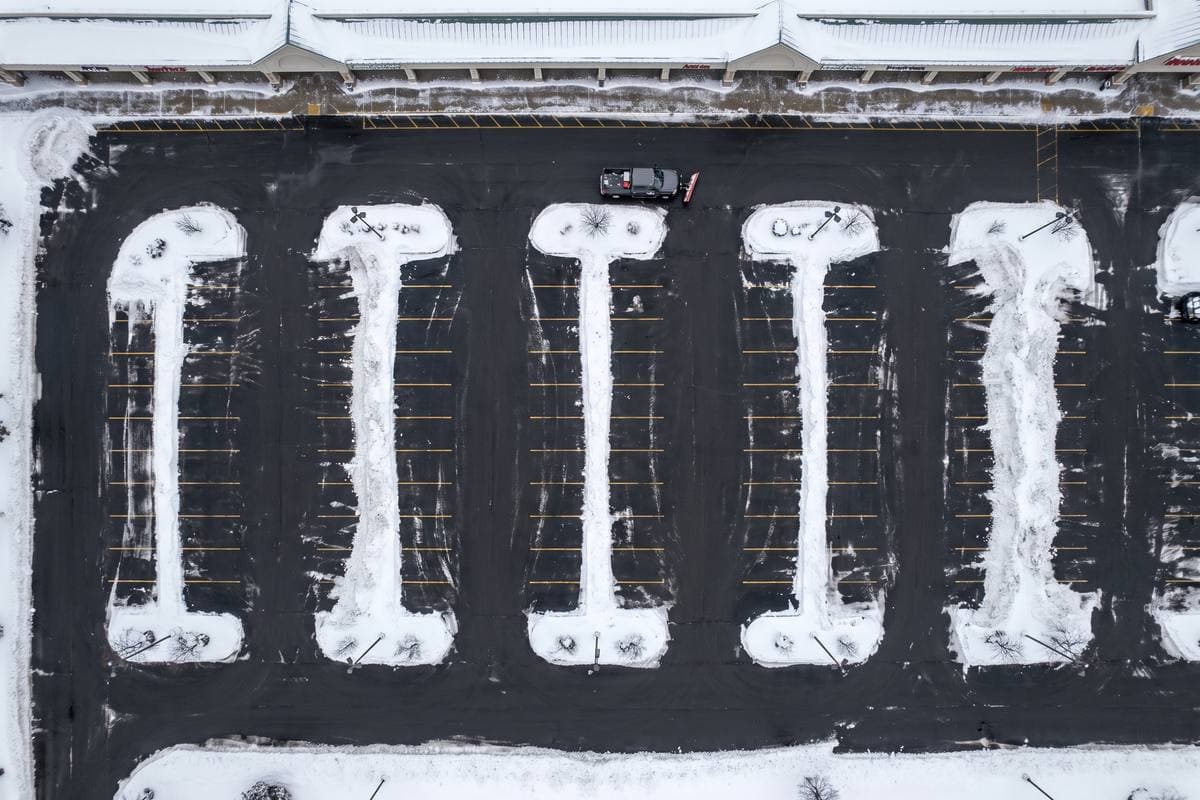
A plowed retail parking lot from above, snow stacked on the curb islands and a pickup with a plow by the storefronts
A cleared retail lot. Every curb, island and parked car in it is something a plow can hit.

How the Rules Change by State

The policies are the same everywhere. What changes is who must carry what, and how far a contract can push the risk onto you. This is not a full list of state rules; ask your agent about yours.

Every state
Workers' comp for private employers runs through each state's own board, so when you must carry it and how it is priced depends on where your crew works.
Colorado
A 2018 law voids provisions of snow removal agreements that require one party to indemnify, hold harmless or defend the other, in the situations the act covers. Contracts with public bodies and utilities, public roads and airports are outside it, and so is an insurance policy. Ask an attorney whether it reaches your contract.
Illinois
Since August 2016, a snow and ice contract cannot make either side indemnify, hold harmless or defend the other for the other's own acts. The act does not apply to an insurance policy.
Some cities
Syracuse, New York licenses private plow contractors and asks for proof of liability, auto and workers' comp insurance to get the license.

Records That Defend a Slip-and-Fall Claim

SIMA notes that a snow contractor can be named in a slip-and-fall suit even where the refreeze was not theirs to treat, and its warning is blunt: unclear or missing documentation will almost certainly cost you if a lawsuit is filed.

The Western Trade Center RFP attaches a site plan of its own as an exhibit, with the areas where snow may be piled marked on it. Keep your own plan for every lot, along with these records.

Before the season

  • A detailed drawing or picture of the property, with its current damage
  • The services, risk areas and where the snow piles go
  • A current, written contract with each customer

Every visit

  • Crew arrival and departure times, and who was on site
  • What was done, and which areas were not serviced and why
  • Photos sent to the office, and every text with the customer

All season

  • Weather service data, filed by customer or location
  • The site map reviewed after the season for anything that changed
MAIN STBUILDINGN
  • Plowed lot and drive lanes48,000 sq ft · 1.10 acresWhat a machine clears. Acres are what every production rate is quoted in.
  • Walks, entries and dock approach2,400 sq ft · 480 linear ftA hand crew's job, at a hand crew's pace. Priced on its own line.
  • Snow stacking: two islands and the NE grass corner6,200 sq ft13% of the lot has to hold a whole winter of piles.
The worked example used across the snow guides — a diagram, not to scale, and not a measurement of a real property.

The first item on SIMA's list is the drawing. For a suburban medical-office plaza, that is the paved lot of 48,000 sq ft, 2,400 sq ft of walks your crew clears by hand, and the 6,200 sq ft where the piles are allowed to go. Marked before the first storm, it shows what you agreed to clear and what you did not.

SurfaceMeasure's Snow Removal mode builds it from an address. Trace the lot and the walks as their own sections on satellite imagery, and the quote lists each one's square footage with the satellite view of what you traced, priced per push, salt and season at your rate. Send it to the property manager, and keep it with the contract as the site map for the season. The visit log on storm nights is a separate record, and you keep it yourself.

Build Your Coverage Checklist

Tell it what your snow business does and it lists the policies, endorsements and paperwork to ask a broker for, with the reason for each. It shows no prices, because nobody publishes them per truck or per lot. Copy the list into an email and ask for quotes on the same terms.

Your snow business

What to ask your broker for

Policies

  1. General liability at $1 million per occurrence and $2 million aggregate, with no snow and ice removal exclusion

    Commercial customers usually require it, and these are the limits Insureon's snow customers carry on average. (Insureon)

  2. Commercial auto on 1 truck, with each plow listed as permanently attached equipment

    Personal auto typically does not cover business use. (Progressive Commercial)

  3. Tools and equipment cover for the walk blowers and spreaders, each item over $2,500 scheduled

    Inland marine covers property that leaves your premises. (SIMA)

Endorsements

  1. The snow plow endorsement on general liability (SIMA names CG 22 92), or your carrier's equivalent

    An unendorsed general liability policy excludes injury and damage from autos. (SIMA)

  2. Additional insured for ongoing and completed operations (CG 20 10 and CG 20 37), blanket where the contract requires it

    Most snow contracts require both, and slip-and-fall claims arrive after the work is done. (SIMA)

  3. Primary and non-contributory wording, and a waiver of subrogation, ready for the contracts that ask

    Owners write these in to keep their own insurance out of a claim on your work. (Central Insurance)

Paperwork for each client

  1. A certificate of insurance for each of your 3 lots, naming its owner and manager, issued before the first push and renewed every year

    Commercial RFPs ask for it before any work. Your 3 additional insureds all share one limit. (The Washington Companies)

  2. A site drawing and a visit log for each of your 3 lots

    Unclear or missing documentation will almost certainly cost you if a lawsuit is filed. (SIMA)

Questions for the broker

  1. Does the policy rate the sidewalks and entrances my crew clears by hand?

    Insureon lists foot traffic among what sets a general liability premium. (Insureon)

  2. Is salting and de-icing written into the description of my operations?

    Insureon lists de-icing, salting and plowing large commercial lots as the higher-risk services. (Insureon)

  3. Is the insurer rated A- or better by AM Best and licensed in my state?

    Owners are told to ask for exactly that. (Central Insurance)

  4. Will you read each contract's insurance and indemnity terms before I sign it?

    SIMA tells contractors to have their agent and their attorney review the requirements. (SIMA)

The certificates and the site drawings start with the lots themselves. Measure each lot's pavement and walks on satellite imagery, then quote it per push, salt and season. Card required, cancel anytime.

Start 7-Day Free Trial

Snow Plow Insurance: FAQ

Insureon publishes what its customers pay: general liability for snow removal contractors at $132 a month ($1,580 a year), and commercial auto at $299 a month ($3,590 a year) for landscaping companies, snow contractors included. Most of those customers have fewer than five employees. Your quote depends on your state, your trucks and their value, your payroll, the services you sell, how many lots you take on and your claims history. Progressive and NEXT publish no snow plow premium.

For commercial lots, yes. Progressive says personal auto insurance typically does not cover business use, and NEXT says a personal policy usually won't pay if you scrape a parked car while clearing a parking lot. You need commercial auto for the truck and its plow, and general liability that covers plowing with an auto: SIMA notes an unendorsed general liability policy excludes auto claims and names the CG 22 92 snow plow endorsement as the fix.

No insurer or agency we read prices a $1 million limit on its own. The closest published figure is Insureon's: snow removal contractors pay $132 a month for general liability, and its customers carry average limits of $1 million per occurrence and $2 million aggregate. Each extra $1 million of umbrella above that runs $75 a month on Insureon's figures.

It is meant to: general liability covers bodily injury your business is found liable for. Check two things. The policy must not carry a snow and ice removal exclusion, which SIMA warns about. And because a fall can happen after your crew has left, clients want cover for completed operations as well as ongoing ones, so most snow contracts require both additional insured endorsements, CG 20 37 and CG 20 10. Your records of each visit decide the rest.

A certificate before any work, the owner and manager named as additional insured, and limits written into the contract. One 2026 commercial RFP, for the Western Trade Center in Missoula, MT, asked for statutory workers' comp, $1,000,000 of employer's liability, $1,000,000 per occurrence, $2,000,000 aggregate of general liability, and $1,000,000 per occurrence of auto liability covering hired, owned and non-owned autos, with the same from every subcontractor.

The policies are the same kinds everywhere, but the rules around them are not. Workers' comp is run by each state. Colorado and Illinois have laws that void certain indemnify, hold-harmless and defend clauses in snow removal contracts. Some cities license plow contractors and ask for proof of insurance, as Syracuse, New York does. Premiums move with location too: Insureon counts heavy, recurring snowfall as a cost factor.

Commercial RFPs usually say so. The Missoula RFP requires the contractor and all subcontractors to carry the same insurance. Collect their certificates before the season, and carry hired and non-owned auto yourself: SIMA points out that if a subcontractor has an accident plowing on your contract, you could be held responsible.

Sources

Each page read October 18, 2026. Premiums are an insurer's published figures, not quotes. Nothing here is insurance or legal advice: talk to a licensed agent in your state before you buy or sign.

Measure the Lots Your Certificates Will Name

Trace each lot and its walks on satellite imagery, price a push, salt and a season at your rate, and send a quote the property manager can accept from a phone. Card required, cancel anytime.