
Equipment Guide
What Size Surface Cleaner Do You Need?
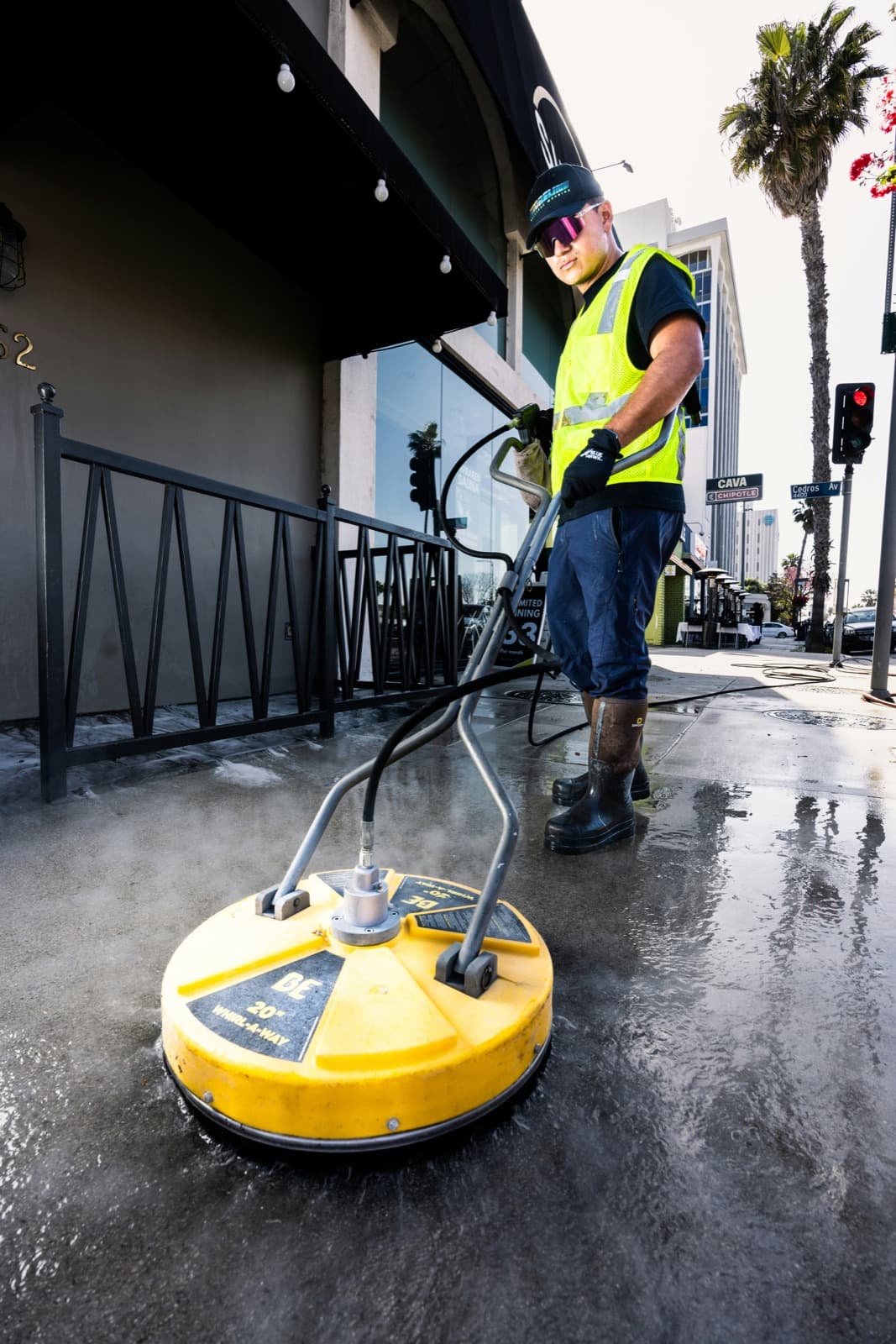
Size a surface cleaner at roughly 4 inches of width per GPM of your machine's flow. A 4 GPM pressure washer runs a 16-inch cleaner, 6 GPM runs a 24-inch, and 8 GPM drives a 28-inch. Pressure barely matters here — flow is what spins the bar.
The width you land on sets your production rate, and production rate is what your per-square-foot price is actually built from. This guide covers both halves: which cleaner your machine will drive, and what that means for the number you quote.
Size it for your machine
Free, no sign-up. Enter your machine's rated flow and it returns the widest cleaner it will actually drive, the production rate to expect, and how long a job of a given size will take.
Your machine
Use the machine's rated GPM, not its PSI. Flow is what spins the bar and carries debris away — pressure alone won't drive a wide cleaner.
Largest cleaner this machine will drive
16"wide
4 GPM across 2 nozzles = 2.0 GPM per nozzle — in the 1.5–2.5 band a spray bar needs. Going wider than this starves the bar and the cleaner drags instead of gliding.
What that means per hour
Realistic production rate on smooth concrete
950–1,250sq ft/hr
On-site rate, not a spec-sheet number — it already accounts for overlap, turns, edging, and trigger-off time. Your own first few jobs are the real calibration.
How long is the job?
Enter a job size to see the cleaning time
Every number below the cleaner width depends on knowing the job's square footage. Don't have it yet? Measure the property from satellite imagery and bring the real area back here.
Surface cleaner size by GPM
Minimum flow is what the width needs to run properly, not a hard limit — a 20-inch cleaner will physically attach to a 3 GPM machine, it just won't clean well. Production rates assume open smooth concrete.
| Width | Min. GPM | Nozzles | Sq ft / hr |
|---|---|---|---|
| 12"2 nozzles | 3 | 2 | 700–900 |
| 16"2 nozzles | 4 | 2 | 950–1,250 |
| 20"2 nozzles | 5 | 2 | 1,250–1,550 |
| 24"3 nozzles | 6 | 3 | 1,500–1,900 |
| 28"4 nozzles | 7 | 4 | 1,800–2,200 |
| 32"4 nozzles | 8.5 | 4 | 2,000–2,500 |
The rule behind the rule. The “4 inches per GPM” guideline is really a proxy for flow per nozzle. A surface cleaner bar carries two, three, or four nozzles, and each one needs somewhere in the range of 1.5 to 2.5 GPM to atomize properly and carry debris off the surface. A 16-inch bar with two nozzles at 4 GPM gives each nozzle 2.0. A 24-inch bar with three nozzles at 6 GPM gives each one 2.0 as well — same math, bigger machine. Once you see it that way, the sizing chart stops being something to memorize.
Which is also why nozzle selection inside the bar matters as much as the bar itself. Each tip has to be sized for its share of the flow, not the machine's full rating — the nozzle chart and orifice calculator has a surface-cleaner mode that does that division for you.
What the surface does to your production rate
Width sets the ceiling. The surface decides how close you get to it.
These are on-site rates, not spec-sheet rates. A 20-inch cleaner is 1.67 feet wide, and walking at a slow, deliberate one foot per second that works out to about 6,000 sq ft per hour on paper. Nobody achieves that. Real output lands near a quarter of it once you account for overlapping passes, turning at each end, edging where the round housing can't reach, moving hoses, and every second the trigger is off. The 1,250–1,550 figure in the chart is what actually shows up on an invoice.
If a number you read anywhere — including here — implies you'll clean 5,000 sq ft an hour with a walk-behind, it's measuring the machine rather than the workday.
Why this is a pricing decision, not a gear decision
Contractors price flatwork by dividing an hourly target by a production rate. Cleaner width moves the divisor, so it moves the rate you can quote and still hit your number. At a $140/hour target:
| Production rate | Price to hit $140/hr | Typical setup |
|---|---|---|
| 700 sq ft/hr12" cleaner or heavy soiling | $0.20 / sq ft | 12" cleaner or heavy soiling |
| 1,000 sq ft/hr16" on smooth concrete | $0.14 / sq ft | 16" on smooth concrete |
| 1,400 sq ft/hr20" on smooth concrete | $0.10 / sq ft | 20" on smooth concrete |
| 1,800 sq ft/hr24–28" on open flatwork | $0.078 / sq ft | 24–28" on open flatwork |
Read that table twice, because it's the whole argument for upgrading. Going from a 16-inch to a 20-inch cleaner doesn't just get you home earlier — it lets you quote $0.10 instead of $0.14 and still earn the same per hour. In a competitive market that spread is the difference between winning the job and coming second.
The catch is that the formula needs a real square footage on the other side. A production rate is only useful against a measured job — guess the area and you've just undermined the precision you bought the wider cleaner for. The hourly vs. per-square-foot guide works through the full pricing method, and the price-per-square-foot rates runs the arithmetic with your own numbers.
What actually matters when you buy one
Once the width is right, the spec sheet stops being useful. These are the things that decide whether a cleaner is still working in two years.
Buy the swivel, not the housing
The swivel is the part that fails. It carries the full pressure while rotating, and a cheap one starts leaking within a season. Housing material — plastic, aluminum, stainless — changes weight and corrosion resistance far more than cleaning quality.
Check the caster wheels
Small hard casters catch on every expansion joint and control joint. Larger wheels roll over them and keep the bar at a consistent height, which is what stops striping. This is the single most overlooked spec on a cleaner.
Match the fitting to your rig
Most contractor cleaners use a 1/4-inch or 3/8-inch quick connect. Check what your wand and hose already run so the cleaner drops into the setup you have instead of needing an adapter that becomes another leak point.
Two sizes beat one compromise
Working contractors usually end up carrying a wide cleaner for open flatwork and a 12- or 14-inch for tight courtyards, balconies, and between-the-cars work. The small one isn't a downgrade — it's the tool that reaches where the big one physically can't.
Surface cleaner sizing — common questions
Flow, width, production rate, and what it all means for the price you quote.
Roughly 4 inches of cleaner width per GPM of flow. A 4 GPM machine runs a 16-inch cleaner comfortably, 5.5 GPM handles a 24-inch, and 8 GPM drives a 28- to 32-inch. The real constraint underneath that rule is flow per nozzle: a surface cleaner bar carries 2 to 4 nozzles and each one needs roughly 2 GPM to spray properly. Divide your GPM by the bar's nozzle count — if the answer drops much below 2, the cleaner is too wide for the machine.
It drags instead of gliding, the bar spins slowly or stalls, and cleaning quality goes patchy — you'll see swirl marks and missed stripes where the nozzles didn't overlap. You end up walking slower to compensate, which cancels out the wider path entirely. An oversized cleaner is slower in practice than a correctly sized smaller one, which is the opposite of why people buy them.
On open smooth concrete, expect roughly 950–1,250 sq ft/hr with a 16-inch, 1,250–1,550 with a 20-inch, 1,500–1,900 with a 24-inch, and 1,800–2,200 with a 28-inch. Those are realistic on-site rates that already include overlap, turns, edging, and trigger-off time — not theoretical width times walking speed, which overstates output by three or four times. Aged or broom-finish concrete runs about 15% slower, pavers about 35% slower, and heavy grime or gum can halve the rate.
Only if your machine has the flow to drive it. Width multiplies your path, but flow determines whether the bar actually spins fast enough to clean at walking speed. Pair a 24-inch cleaner with a 4 GPM machine and you'll cover less ground per hour than the same machine with a 16-inch, because you have to crawl. Match the width to the flow first, then the width increase is real.
Because it sets your price. The formula contractors use is hourly target divided by production rate equals price per square foot. At 1,000 sq ft/hr and a $140/hr target you need $0.14/sq ft; at 1,500 sq ft/hr the same target only needs $0.093. That's the entire business case for a wider cleaner — it isn't about finishing early, it's about the rate you can quote and still hit your hourly number.
For most contractors, no. Housing material affects weight and corrosion resistance far more than cleaning performance — the swivel, the bar, and the nozzles do the actual work. Plastic housings are lighter and cheaper and hold up fine on residential flatwork; stainless and aluminum earn their price on daily commercial use where the machine lives in a trailer and gets abused. Spend the money on a good swivel before you spend it on the housing.
Yes, and it's usually the better tool — a surface cleaner applies more even pressure than a wand, which is exactly what stops you from striping the surface or blowing out joint sand unevenly. Expect roughly a third less production than smooth concrete because you move slower and often need a second pass. Price that in: pavers commonly carry a higher per-square-foot rate for precisely this reason.
Time yourself on a job you've measured. Note the square footage, start the clock when the cleaner touches the surface, and stop when the last pass is done — excluding setup, breakdown, and moving hoses. Do that across three or four jobs and you'll have a number specific to your machine, your walking pace, and your local soiling. Every rate on this page is a starting point until you have that.
Related Resources
From gear to production rate to the price on the quote.
You have the rate. Now get the area.
Production rate only turns into a price when you know the square footage. Measure any driveway, lot, or patio from satellite imagery in minutes — no site visit.